

Customer Application Case
Effective filter chamber volume per batch: 330 L | Single cycle duration: ≤60 min
Project Background
The customer is a condiment manufacturer. Before moromi (soy sauce mash) enters the subsequent blending process, solid–liquid separation must be completed. The material has a solids content of approximately 50% and relatively high viscosity. After feeding, a filter cake layer quickly forms on the surface of the filter cloth, and filtration resistance rises rapidly. Therefore, the equipment must be well matched in terms of filter chamber volume, squeezing capacity, and batch cycle rhythm.
Table 1 Customer Requirement Indicators
| Item | Customer Requirement |
|---|---|
| Effective filter chamber volume per batch | 330 L |
| Single filtration cycle duration | Not more than 60 min |
| Separation performance | Sufficient filtrate recovery; stable filter cake formation and easy transfer |
In the early stage, the customer compared multiple chamber-type and membrane-type models. Considering the filter chamber volume matching, squeezing dewatering capacity, and single-batch cycle efficiency, the customer finally selected a Model 700 membrane filter press, equipped with a pneumatic diaphragm pump for feeding and an air-blow function.
Analysis of Operating Difficulties
- High solids proportion: A dense filter cake layer forms on the filter cloth surface at the initial stage of feeding, and feeding resistance rises rapidly. If the squeezing capacity is insufficient, the single-batch cycle is easily prolonged.
- Corrosive medium: The medium is saline and corrosive. Material selection for filter plates, cloth, and seals is critical to prevent leakage and failure.
- High material viscosity: Slurry is likely to remain in channels. After shutdown, it dries and hardens, causing poor feeding or pipe blockage.
- Fixed production rhythm: Long-term material blockage or slow filtrate flow is unacceptable for batch scheduling.
- Stable dewatering effect: Need to reduce residual liquid phase and ensure filter cake has sufficient forming strength.
Solution Configuration
In response to the above operating conditions, the equipment was configured according to the concept of “volume matching + membrane squeezing + stable feeding + channel purging.”
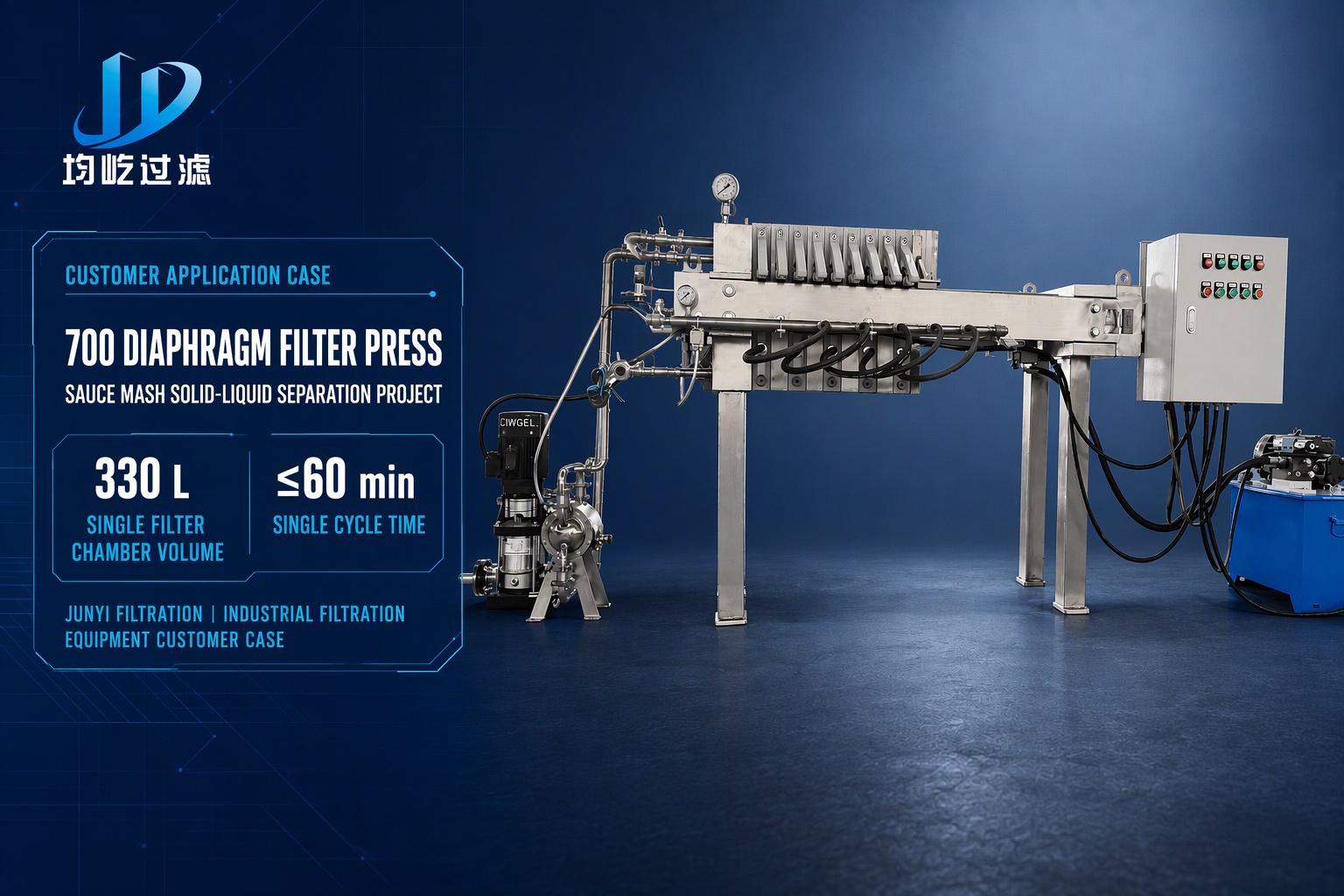
Table 2 Main Equipment Configuration
| Configuration Item | Parameter / Description |
|---|---|
| Equipment model | Model 700 membrane filter press |
| Filter plate specification | 700 × 700 mm membrane filter plates |
| Total filter chamber volume | 330 L |
| Feeding method | Pneumatic diaphragm pump |
| Additional function | Air-blow system (compressed air purging of feed channels) |
| Control mode | Program-controlled automatic operation sequence |
| Feed pressure | 0.4–0.6 MPa |
| Membrane squeeze pressure | 1.0–1.4 MPa |
The selection was based on: First, volume alignment (330 L) to avoid waste or inefficiency. Second, the pneumatic diaphragm pump’s ability to handle high-viscosity materials without rotating seals. Third, the air-blow system which eliminates residual slurry hardening in the flow channels.
Operating Process and Measured Results
- Entire process stably controlled within 60 minutes.
- Pneumatic pump filling speed was stable without damaging filter cloth.
- Pipeline cleaning frequency significantly reduced via air blowing.
- Filtrate clarity met subsequent process requirements.
- Filter cake was compact, well-formed, and easy to discharge.
- Stable operation under saline conditions with no leakage.
Solution Advantages
VI. Customer Feedback
“The equipment operates stably and is easy to maintain. Problems such as uncontrollable cycles, high moisture, and pipeline blockage were all significantly improved. The solid-liquid separation effect met our expectations.”
VII. Case Summary
This case provides a reusable selection reference for batch production of sauce products. Key control points: volume matching, secondary squeezing, and channel air blowing.
Post time: Nov-23-2026