

I. Project background
A medium-sized food processing enterprise focuses on fried food and meat processing, and produces a large amount of high oil wastewater in the production process, which contains pollutants such as food residues, animal and plant oils and proteins. The water quality of the wastewater fluctuates greatly, the oil content is high, and the direct discharge is easy to lead to pipe blockage and water eutrophication. According to the production scale calculation of the enterprise, the wastewater discharge is 2.5m³/h. In order to meet the requirements of environmental protection and achieve sustainable development, enterprises need to build a set of efficient and stable wastewater treatment system with compact footprint to ensure that the effluent reaches the standard and realize the reduction of sludge disposal.
Ii. Core pain points of customers
High oil content is difficult to deal with: the oil content of wastewater is ≥80mg/L, and the conventional treatment process has poor separation effect on emulsified oil, which is easy to lead to blockage of subsequent treatment units, low efficiency, and high maintenance costs.
The processing capacity of the original equipment is insufficient: the existing simple equipment cannot match the discharge demand of 2.5m³/h, and the effluent water quality fluctuate greatly, resulting in the risk of exceeding the environmental protection standard.
Dual constraints of site and disposal: the plant covers a limited area, requiring compact and efficient treatment system, and solving the problem of sludge disposal to avoid secondary pollution.
3. Customized solutions
According to the characteristics of high oil wastewater and the actual needs of customers, the integrated treatment process of “pretreatment + coagulation precipitation + diaphragm pressure filtration and dehydration” is designed, and the pharmacy dosing and sludge dewatering are optimized to realize efficient oil removal and stable operation.
1. Process flow
In the pretreatment stage, the wastewater first passes through the mechanical grid to remove large particles of food residue, and then enters the advection oil trap, and the gravity separation principle is used to remove the oil slick (removal rate ≥60%), which significantly reduces the subsequent treatment load.
Coagulation and flocculation stage: After pretreatment, the wastewater enters the coagulation reaction tank, and PAC (polyaluminum chloride) and PAM (polyacrylamide) are added in turn through the precise metering pump. PAC destroys the emulsion state of oil, PAM promotes the flocs condensation, forming oil-containing flocs that are easy to precipitate, and realizing the efficient separation of oil, water and solid three phases.
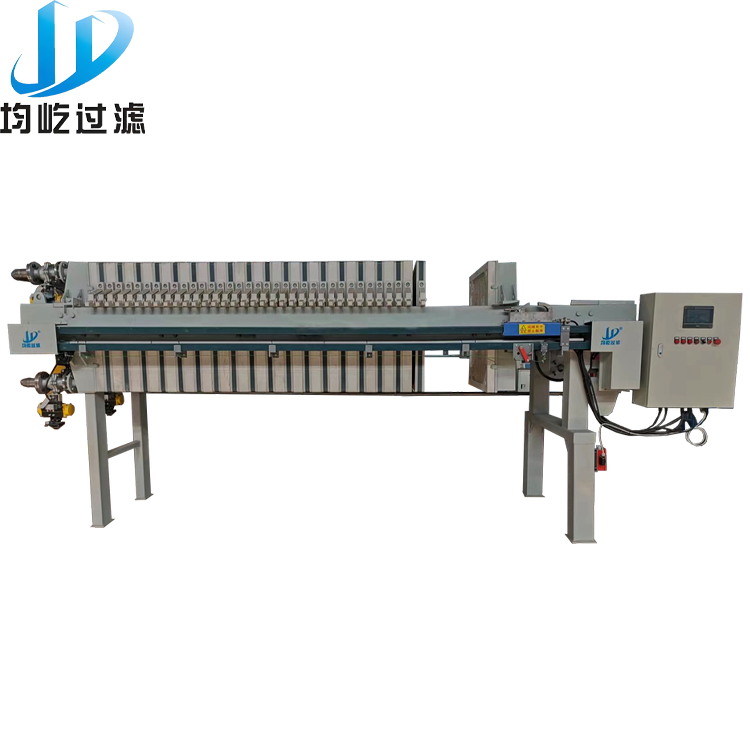
Solid-liquid separation and dehydration stage: after coagulation, the wastewater flows into the sedimentation tank for separation of mud and water, and the supernatant is discharged to the standard. The oily sludge at the bottom is pumped into the diaphragm filter press, and the moisture content of the sludge is reduced to below 60% by the high-pressure diaphragm extrusion and dehydration, forming a solid mud cake for external transportation and disposal. The filtrate of the pressure filter is returned to the pretreatment unit to realize the closed treatment of the wastewater in the whole process.
2. Key equipment and operating parameters
The core of the processing system adopts an integrated reaction precipitation equipment with a processing capacity of 2.5m³/h, and a 30㎡ diaphragm filter press.
PAC dosage: 50-80mg /L, PAM dosage: 3-5mg /L, according to the influent water quality real-time adjustment, to ensure optimal treatment effect;
The system is equipped with intelligent control system to realize the automatic operation of pharmacy dosing, sludge dewatering and other links, and reduce the intensity of manual operation.
Iv. Project implementation effect
The effluent quality is stable and up to standard: after the system is put into operation, the oil content of the effluent is reduced to less than 5mg/L, and other indicators are in line with local discharge standards;
The sludge reduction effect is remarkable: the diaphragm filter press reduces the moisture content of the sludge to less than 60%, and the sludge volume is reduced by about 70%, which greatly reduces the disposal cost;
Easy operation and maintenance: the integrated design covers a small area, high degree of automation, low daily maintenance workload, stable and reliable long-term operation.
V. Case summary
Through customized integrated pretreatment, coagulation precipitation and high-pressure diaphragm dehydration process, this case effectively solves the difficulties of high oil wastewater treatment in food processing enterprises. The system has high efficiency, stability and compactness, which not only ensures that the effluent reaches the standard, but also realizes the reduction and resource disposal of sludge, providing customers with economic and feasible environmental protection solutions.
Post time: Dec-15-2025