

Project Background
The client is a metallurgical processing enterprise that mainly produces sheet and strip materials as well as profile products. Its hot rolling and cold rolling production lines are equipped with a circulating cooling water system, which is used for cooling the rolls, bearings, and hydraulic stations. The original system adopted a combination of Y-type filters and bypass reverse flushing filters. During operation, two problems gradually emerged: Firstly, the fine iron oxide scale and oil sludge produced during the rolling process mixed and adhered to the filter screens, making it difficult to completely remove through backwashing, and the pressure difference rose rapidly; Secondly, cleaning required stopping the machine and switching, which affected the continuous supply of cooling water, especially during high-load production periods. The manual cleaning frequency was high and the labor intensity was great.
The enterprise hopes to stabilize the control of fine particle impurities in the cooling water at a level of 20 microns or less without stopping the machine or requiring much manual intervention, to ensure the normal operation of the downstream heat exchangers and nozzles.
Solution
Based on the on-site condition assessment, the customer selected the JYSCF-200-304 self-cleaning filter. The main configuration and selection basis are as follows:
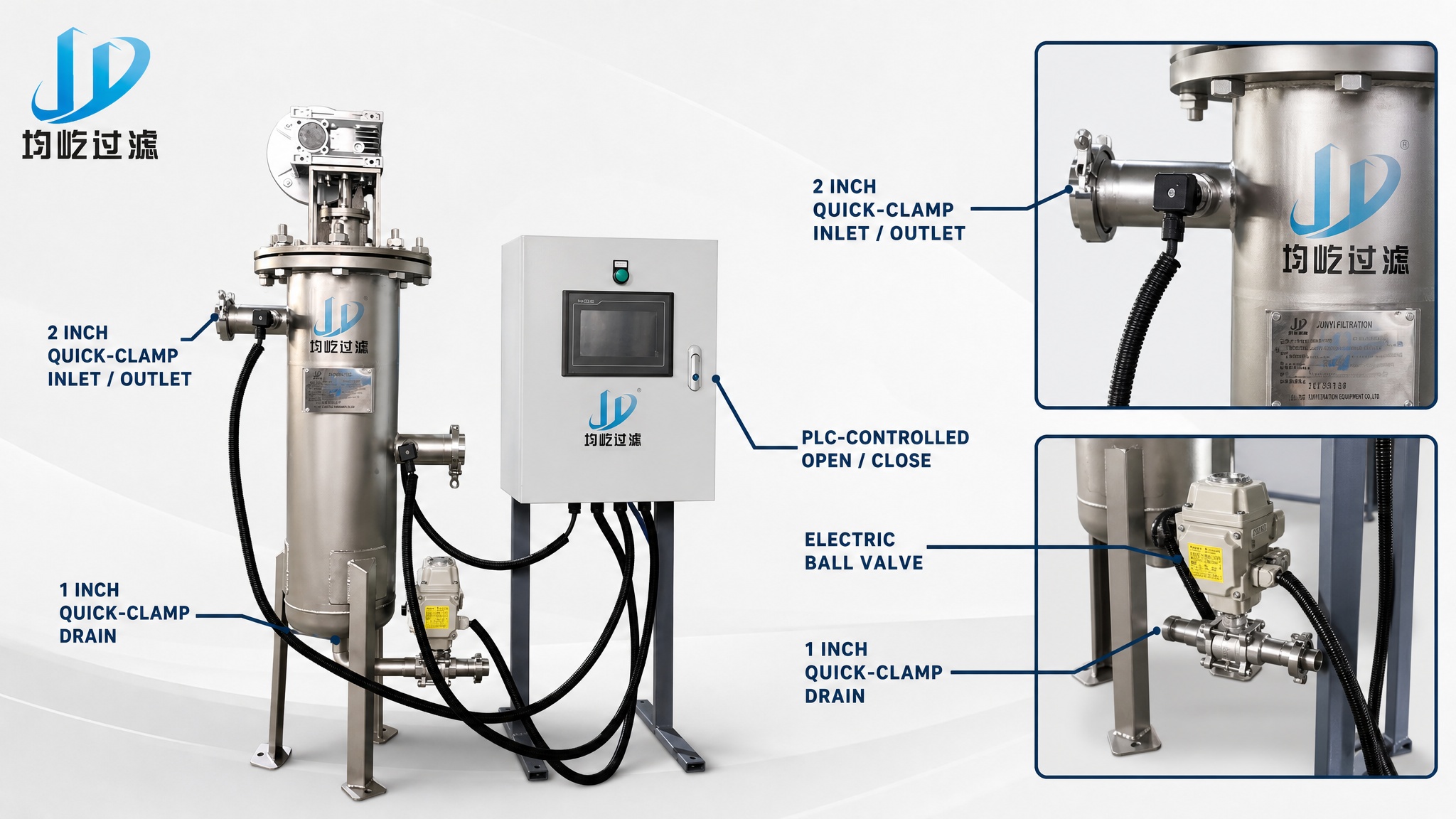
The particle size of iron oxide scale in the rolled cooling water is mostly in the range of 20–100 microns. The 20-micron wedge-shaped screen can effectively intercept fine particles and protect the downstream heat exchanger tubes and spray nozzles.
For the working condition of mixed oil sludge and iron powder, the scraper mechanically removes directly on the filter screen surface, which is more effective in removing sticky impurities than simple backwashing; the surface gap of the wedge-shaped screen filters and the outer narrow and inner wide structure allows impurities to be retained on the incoming flow side, facilitating scraping.
It can be quickly connected to the original pipeline, with a short installation period; the side-in and side-out layout adapts to the on-site pipe rack direction, and the 1-inch bottom discharge port utilizes the gravity direction to discharge the sludge.
It automatically starts cleaning and discharging according to the inlet and outlet pressure difference and the set cycle, achieving unmanned continuous operation.
After the equipment was put into operation, the single unit processing flow was determined to be within the range of 20–40 m³/h based on the impurity content of the medium and the allowable pressure difference. The surface flow velocity of the filter screen was controlled at 0.5–1.5 m/s, and the pressure difference reached the set value, triggering automatic cleaning.
Operation results
After approximately 6 months of continuous operation, the customer reported the following main improvements:
- • Pressure difference stability: The inlet and outlet pressure difference has been maintained below the set cleaning threshold for a long time, without the rapid increase of pressure difference during the backwashing period of the filter. The cleaning frequency has been reduced from multiple times per shift to automatic triggering as needed.
- • Continuous water supply without shutdown: The self-cleaning and discharging process does not affect the main process water supply, and the cooling water supply is continuous during high-load production periods, reducing process fluctuations caused by switching cleaning.
- • Decrease in manual maintenance: From the previous need to regularly shut down and disassemble the filter screen, it has now been mainly based on PLC automatic discharging, with only regular inspections of the discharge pipeline and the operation of the electric ball valve required by the operator. The maintenance workload has significantly decreased.
- • Protection of downstream equipment: Complaints of blockage of heat exchanger tubes and spray nozzles have decreased, the frequency of nozzle replacement has dropped, and the cooling effect has been stable.
- • Good filter screen condition: During maintenance, the SS304 wedge-shaped screen was inspected, with no obvious deformation in the gaps, and the 20-micron accuracy has been maintained stably. The wear of the scraper edge is within the normal range.
“This scraper self-cleaning filter has solved our long-standing problem with iron powder, oil sludge, and mud clogging in the cooling water. The pressure difference no longer triggers frequent alarms. Cleaning does not require downtime, the discharge valve operates automatically, and the on-site workers no longer need to disassemble the filter screens. The SS304 material has not shown significant corrosion in the cooling water environment, and it is relatively easy to operate after running for half a year.”
— The customer’s equipment supervisor
Summary of the Case
This case demonstrates that in industrial cooling water conditions with mixed viscous impurities and fine particles, using SS304 scrapers in combination with SS304 wedge-shaped screens and a 20-micron precision self-cleaning filter can make up for the shortcomings of single backwashing by means of mechanical removal. Combined with PLC automatic discharge control, it enables continuous filtration without downtime and low manual maintenance operation. This configuration is of reference value for cooling fluid and circulating water filtration in industries such as metallurgy, machining, and surface treatment. The specific selection still needs to be evaluated and customized by the factory based on the medium viscosity, impurity content, and allowable pressure difference.
Post time: Nov-07-2026