

With the in-depth implementation of the green development philosophy, solid-liquid separation equipment serves as a key support for environmental governance and industrial upgrading. Its performance and compatibility directly affect enterprises’ production efficiency, environmental compliance standards and overall operating costs.
Boasting the unique advantages of filtration + secondary squeezing, the diaphragm filter press is widely applied in municipal environmental protection, chemical, mining, new energy and other industries. It has become core equipment for enterprises to achieve high-efficiency dewatering and energy saving. To help customers across industries fully understand diaphragm filter presses and accurately match production requirements, this article provides a detailed analysis of its working principle and operational process based on industry practical experience.
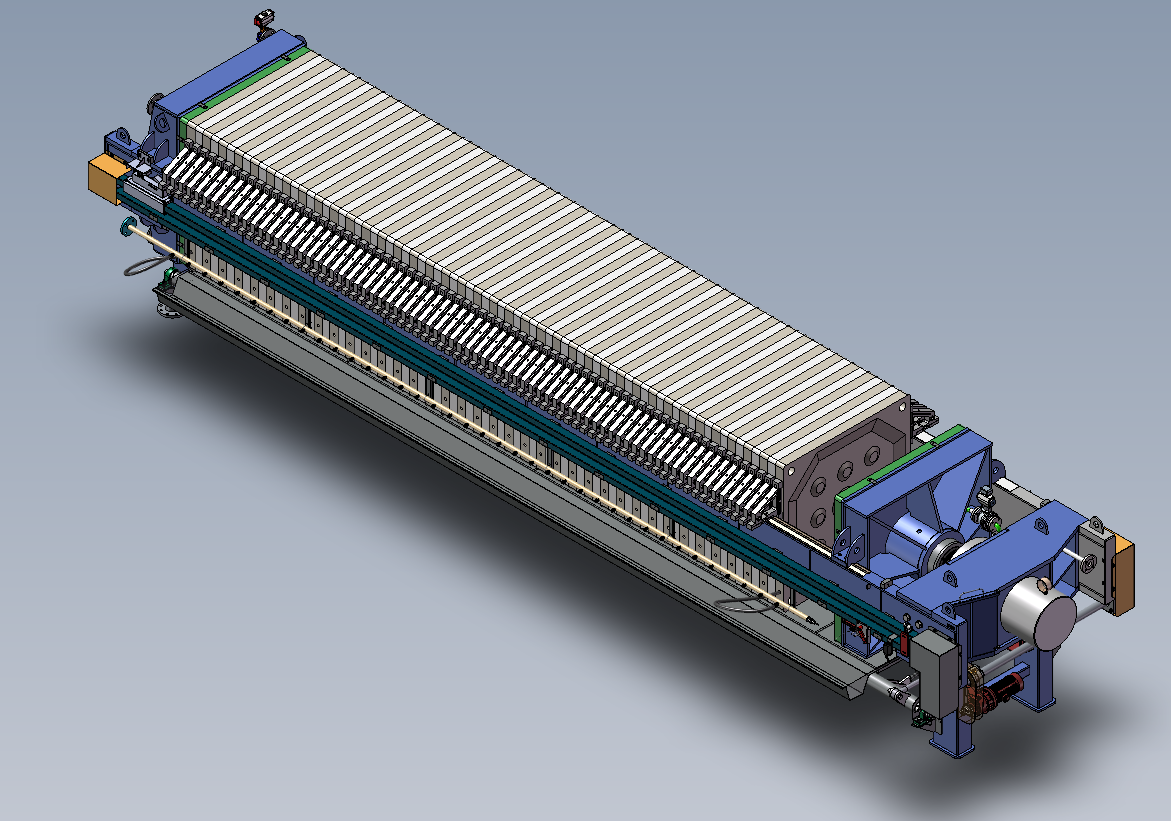
I. Core Working Principle: Dual Dewatering to Pave a New Path for Efficient Solid-Liquid Separation
The diaphragm filter press is an upgraded high-efficiency solid-liquid separation device developed from traditional filter presses. Its core advantage lies in the dual dewatering mechanism of filtration plus diaphragm squeezing. Unlike conventional filter presses that rely solely on feed pressure for single-stage filtration, it delivers far more thorough solid-liquid separation results.
The equipment mainly consists of a frame, filter plate assembly, diaphragm structure, hydraulic compression system, feeding system and diaphragm pressurization system. The filter plate assembly is arranged alternately with standard filter plates and diaphragm filter plates. Each diaphragm filter plate is equipped with an elastic diaphragm inside, forming an independent pressurization chamber with the filter plate body. Water or compressed air can be used as the pressurizing medium to drive the diaphragm to expand and deform.
Essentially, its working principle combines traditional pressure filtration with controllable mechanical extrusion. Firstly, the hydraulic system compresses the filter plates to form sealed filter chambers. The suspension is pumped into the filter chambers under feed pressure; liquid passes through the filter cloth to form filtrate and is discharged, while solid particles are trapped to form an initial filter cake.
Afterwards, high-pressure medium is injected into the diaphragm chamber via the diaphragm pressurization system, causing the diaphragm to expand and apply uniform and continuous squeezing force to the filter cake. This further removes free water and capillary water remaining inside the filter cake, realizing deep dewatering and greatly reducing filter cake moisture content — this is the core technical advantage of diaphragm filter presses over traditional models.
II. Standard Operational Process: Six-Step Closed Loop for Efficient and Stable Operation
The operational process of the diaphragm filter press is logically structured and well-connected, forming a complete closed loop from filter plate compression to cake discharge. The whole process supports automatic control, greatly reducing manual intervention and suiting large-scale production demands. The specific procedures are as follows:
Filter Plate Compression
Before operation starts, the hydraulic system pushes the movable end filter plate toward the fixed end, tightly compressing all filter plates to form sealed filter chambers. This ensures no material leakage during subsequent filtration and squeezing, laying a sealed foundation for solid-liquid separation.
Feeding and Filtration
The suspension is injected into each filter chamber through the feed pump. Under feed pressure, liquid passes through the filter cloth and drains from the filter plate discharge channels, while solid particles are intercepted by the filter cloth and gradually accumulate to form an initial filter cake. As the filter cake thickens, filtration resistance increases and filtrate flow decreases. The primary filtration stage ends when the feed pressure reaches the set value.
Diaphragm Pressurization and Squeezing
After feeding stops, the diaphragm pressurization system is activated. High-pressure medium is delivered to the pressurization chamber of the diaphragm filter plate, making the diaphragm expand toward the filter chamber and apply even squeezing force to the formed filter cake for deep dewatering. This stage is critical for lowering filter cake moisture content and represents the core feature of diaphragm filter presses.
Pressure Holding and Steady Dewatering
Once the diaphragm reaches the set pressure, the system maintains pressure holding status. This ensures uniform pressure distribution inside the filter cake, prompting residual moisture to continuously migrate and drain out for improved dewatering effect. Meanwhile, the filter cake forms a denser and more stable structure for easy subsequent discharge and transportation.
Pressure Relief and Filter Plate Opening
After dewatering is completed, the diaphragm pressurization system relieves pressure and the diaphragm retracts to its original state. The hydraulic system then releases the main compression force, and the movable end filter plates are opened one by one to prepare for cake discharge.
Cake Discharge
The filter plates are separated sequentially, and the filter cake falls off naturally from the filter cloth under its own weight or with auxiliary devices. After discharge, the equipment automatically enters the next working cycle to realize continuous and efficient operation.
We will stop here for this introduction. In our next article, we will continue to elaborate on the applicable working conditions and scientific selection guidelines of diaphragm filter presses. See you next time.
Post time: May-14-2026