

A certain water quality analysis project in South Korea required the installation of a reliable filtration barrier in the river water pre-treatment stage. As river water is a surface water source, its turbidity fluctuates significantly with the seasons. During the rainy season, the sand content increases sharply, and the water contains sediment, algae, and organic debris. If these impurities directly enter the downstream water quality analysis equipment, it will not only increase the analysis error but also accelerate the blockage of downstream filter elements and shorten the equipment lifespan. The customer specified the operating conditions as constant temperature, a flow rate of 20-30 m³/h, a filtration accuracy of 100 microns, and required the filtration equipment to have online self-cleaning capabilities to avoid frequent shutdowns and disassembly for cleaning due to filter screen blockage, thus affecting the continuity of the analysis process.
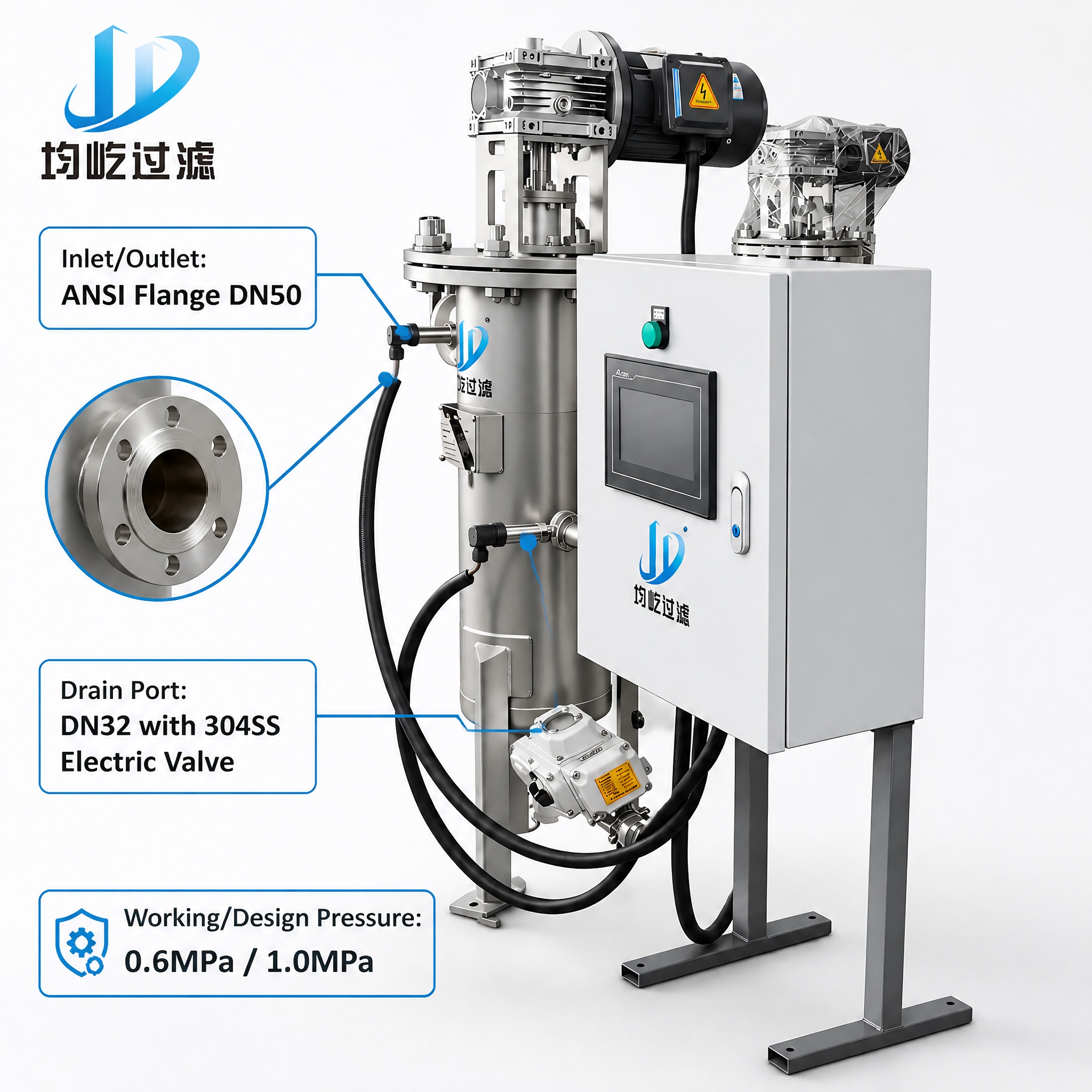
To meet this requirement, the project selected the JYSCF-200-304SS self-cleaning filter. The equipment cylinder has a diameter of 219mm and a wall thickness of 3mm. The filtration body and filter screen are made of 304 stainless steel, with surface sandblasting treatment. The sealing ring is made of EPDM material, the inlet and outlet are DN50 ANSI flanges, the sewage outlet is DN32 with a 304SS electric valve, the working pressure is 0.6MPa, the design pressure is 1.0MPa, and the power supply is 380V three-phase 60Hz, adapting to the local power grid conditions.
The cleaning mechanism is the core design of this equipment to cope with the fluctuations in river water quality. The entire machine uses nylon brushes for cleaning, triggered by the pressure transmitter and timer together, and the PLC control cabinet uses Siemens S7-200 with a display. The pressure difference trigger can respond promptly to sudden changes in water quality, while the timer trigger serves as a fallback to prevent the pressure difference sensor from malfunctioning due to algae adhesion. The combination of the two ensures the continuous stability of the water supply for the analysis process.
In terms of spare parts configuration, the customer adopted a forward strategy: along with the entire machine, one wedge-shaped net with a precision of 20 microns, one with 50 microns, and one with 150 microns were purchased, as well as a set of PP scrapers. The wedge-shaped nets have uniform gaps and can be repeatedly cleaned and reused. The three precisions cover different requirements from fine analysis to coarse filtration – 20 microns is used for the most stringent detection nodes, 150 microns is used for coarse protection during high turbidity periods, and 50 microns is a compromise choice for daily operation. The PP scrapers can provide an auxiliary mechanical scraping method in addition to the nylon brush cleaning, extending the maintenance cycle of the brush body. This configuration turns “filtering precision switching” into a daily operation that can be executed at any time, rather than a passive maintenance that requires waiting for cross-border delivery, and its actual value often becomes apparent in the first rainy season.
For delivery, the equipment is packaged in a quick-opening wooden box, and the factory directly delivers it to the designated warehouse of the Korean customer in DDP mode. The entire machine and spare parts are delivered together. The customer does not need to handle the export customs declaration and Korean import customs clearance procedures themselves. After the equipment is put into operation, the 100-micron precision is responsible for the daily interception task, and the pressure difference and timer dual-control cleaning mechanism maintains continuous operation; when the analysis process requires higher requirements for the water inlet, the 20-micron wedge-shaped net can be quickly replaced and put back into use. A set of filter, three precisions, and matching spare parts form a practical balance solution between stable operation and flexible adjustment for this project.
Post time: Nov-21-2026