

Introduction
Recently, our dedicated customer advisor Peter completed multiple in-depth technical consultations with overseas wood heat-treatment client John Fairweather. Addressing the client’s challenge of removing impurities from 6,000L rapeseed oil used as thermal transfer medium, Peter tailored a high-cost-performance stainless steel bag filter solution—Model 2—based on site-specific parameters including pump specifications, pipeline dimensions, operating temperature range, types of contaminants, and maintenance budget. After confirming the proposed solution, the client made an advance payment via cross-border transfer, and production has now been scheduled. This collaboration exemplifies our company’s success in customizing filtration equipment to meet non-standard industrial conditions and serve the global wood processing industry.
1. Client Site Conditions and Core Filtration Challenges
The client specializes in wood heat-treatment processes, using 6,000L of rapeseed oil as the heat-transfer medium to immerse entire pallets of wood into heated tanks for modification. Over prolonged operation, significant amounts of wood dust, resinous semi-solid sludge, and other debris accumulate within the oil, creating multiple operational constraints and filtration challenges:
1. Intermittent filtration operations: The tank lacks an internal circulation pump; filtration is only performed during plant shutdowns. There is no need for rapid, high-flow filtration—only periodic maintenance to maintain oil cleanliness.
2. Wide temperature fluctuation: Ambient winter temperatures drop to 8–10°C, increasing oil viscosity and filtration resistance. During filtration, oil can be heated to 80–100°C to assist the process. The client required confirmation that the equipment could operate effectively under both ambient and elevated temperature conditions.
3. Non-standard piping and pumps: The storage tank originally features a 50mm outlet, which the client connects via a reducer to a 25mm flexible rubber hose. Replacing existing piping is not feasible, and the pump used is a small gear-type transfer pump.
4. Confusion between two filtration options: The client simultaneously evaluated fully automatic self-cleaning filters and bag filters, comparing initial purchase costs and long-term consumable and maintenance expenses.
5. Moderate filtration precision requirement: High-precision filtration is unnecessary; simply capturing large particles such as wood chips and clumps of oil sludge suffices for production needs.
6. Long-term cost control: The client desired reusable filter bags to minimize replacement frequency and reduce ongoing operational costs.
2. Comprehensive Site Assessment and Dual-Solution Comparison to Identify Optimal Equipment
During the initial consultation, advisor Peter verified five key parameters—flow rate per hour, working pressure, oil temperature, filtration accuracy, contaminant type, and procurement/delivery lead time—and provided professional answers to the client’s questions. He then compared the advantages and disadvantages of two filtration solutions:
Solution 1: Fully Automatic Self-Cleaning Filter
Advantages: Fully automatic online cleaning and drainage, requiring no manual supervision; high dirt-holding capacity enables continuous 24/7 filtration.
Disadvantages: Purchase cost is eight times higher than that of a bag filter. Since filtration occurs only intermittently during shutdowns, the equipment’s cost-effectiveness is extremely low and does not match the client’s actual usage scenario.
Solution 2: Model 2 Stainless Steel Bag Filter (Client’s Final Selection)
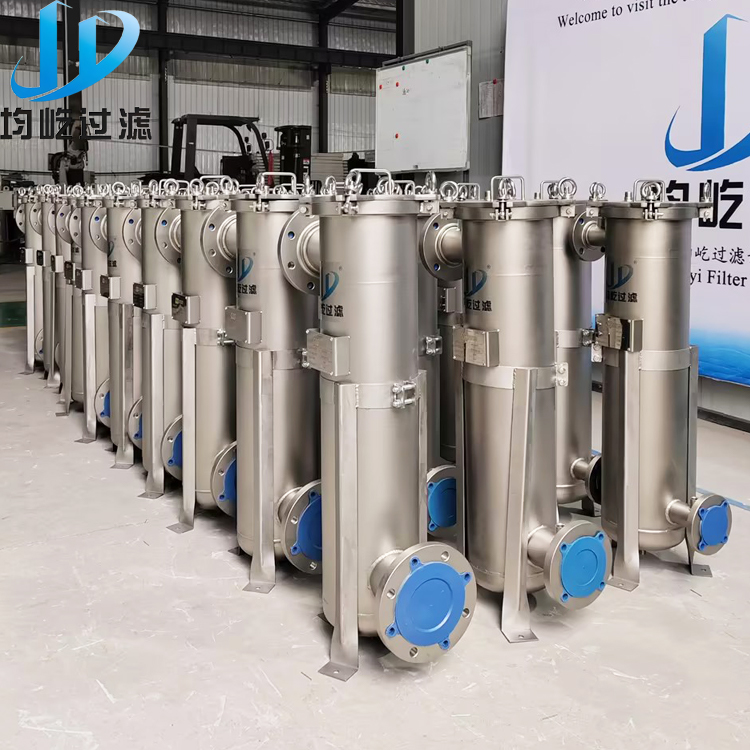
1. High-temperature material compatibility: Entire unit constructed from stainless steel, capable of enduring prolonged exposure to 80–100°C rapeseed oil without leakage or seal degradation.
2. Precise filter media matching: Standardized Model 2 filter bag (180×810 mm), equipped with 50μm PP filter bags, efficiently captures wood chips and semi-solid oil residues. The robust PP material allows for repeated washing and reuse. As a result, the client reduced their initial plan of purchasing 10 filter bags to just 5, significantly lowering consumable costs. 3. Compatible with small transfer pumps: The equipment features a low-pressure drop design, perfectly matching the customer’s 50–70 L/min small gear transfer pump without increasing pump load, ensuring smooth circulation and filtration;
4. Customized inlet and outlet piping: Based on the customer’s requirement for 25 mm rubber hoses, the filter’s inlet and outlet are uniformly customized to 25 mm diameter, compatible with existing transition piping—eliminating the need for additional steel pipe procurement;
5. Designed for intermittent production operations: With a simple structure, the unit allows quick disassembly, replacement, and cleaning of filter bags during production downtime. Without complex electrical control systems, it offers low operational complexity and seamlessly fits the customer’s intermittent filtration needs.
Professional advice on oil temperature: Bag filters can operate normally at ambient temperatures of 8–10°C in winter. Heating to 60–80°C only reduces oil viscosity and increases filtration flow rate—it is not mandatory. Customers may flexibly adjust filtration temperature by season to minimize heating energy consumption.
III. One-Stop Customization Service and Full-Process Support to Facilitate Cooperation
During communication, advisor Peter systematically addressed all customer inquiries—including filter bag dimensions, pump compatibility, filter bag reusability, pipe diameters, and quotation adjustments—by providing technical written explanations, product photos, system connection diagrams, equipment demonstration videos, and detailed quotations. Upon any changes in customer requirements, revised proforma invoices were promptly issued. After confirming all technical specifications and pricing, the customer completed an international bank transfer for the deposit. Both parties established dedicated overseas communication channels to ensure seamless coordination throughout the entire process of production, shipping, and delivery.
IV. Industry Value of the Solution
This customized bag filter solution for thermal oil in wood heat treatment precisely addresses common industry challenges: alternating high- and low-temperature operations, use with small-scale pumps, intermittent filtration, and strict maintenance cost control. Compared to expensive fully automatic self-cleaning systems, this solution offers lower initial purchase costs and reusable consumables, making it ideal for daily thermal oil purification needs in medium- and small-scale wood heat-modification enterprises.
Leveraging our comprehensive service model—including thorough site condition assessment, custom non-standard pipe fittings, temperature-specific technical guidance, and transparent cost comparison—we continue expanding into overseas industrial thermal oil purification markets. Moving forward, we will further deepen our expertise in niche sectors such as wood processing, biomass heat treatment, and thermal oil circulation, delivering highly adaptable, cost-effective customized filtration solutions. Conclusion
This collaboration with overseas customers in the field of thermal modification of wood exemplifies our company’s service philosophy: “assess operating conditions first, then customize solutions, and provide technical support throughout the entire cycle.” Going forward, we will continue to refine our technical engagement processes for international clients, delivering tailored filtration solutions for diverse non-standard industrial fluid applications. Relying on consistent product quality and professional technical services, we aim to steadily expand our global market presence.
Post time: Jul-10-2026