

Customer background
The client is an automotive parts coating enterprise, mainly engaged in surface coating processing of metal parts. The production line includes pretreatment, electrophoretic coating and topcoat processes. The pretreatment line has multiple slot liquid circulation stations. During the circulation process of the slot liquids, iron filings, dust and reaction products will continuously accumulate. It is necessary to control the particle content through filtration equipment to ensure the adhesion of the subsequent coatings.
Customer requirements
The enterprise originally had several old filters scattered at various tank liquid workstations, which presented three issues:
The customer hoped to replace the filter equipment at each workstation of the pre-treatment line at once, with a unified model and specification, a filtration accuracy of around 50 microns, and ease of spare parts management and daily maintenance.
Solution Configuration
Based on the pipe lines and process parameters at each workstation on site, a total of 6 JYSF-#2/304 bag-type filters were configured, installed at each tank liquid circulation workstation of the pre-treatment line:
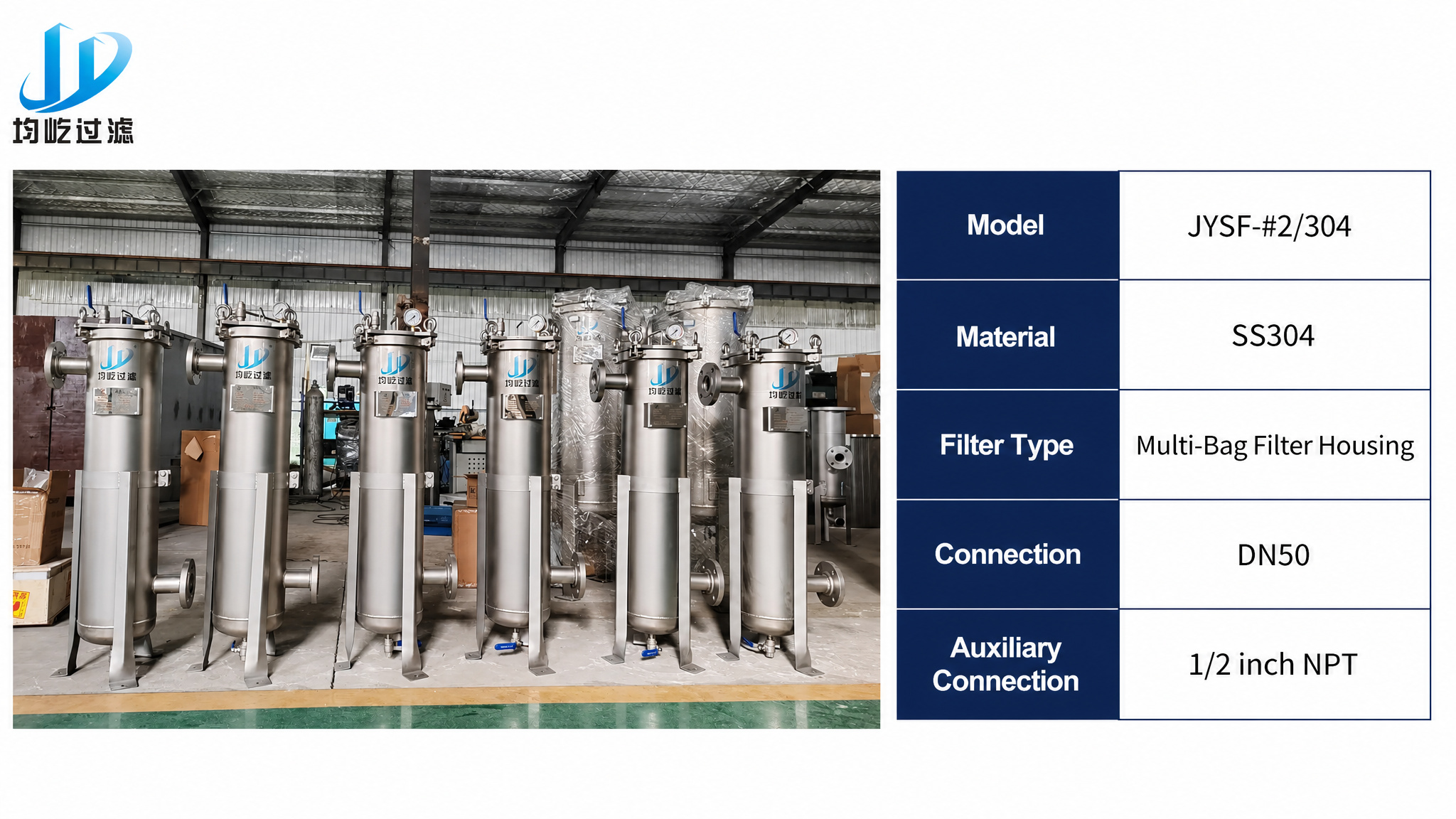
- • The cylinder body is made of SS304 and has a sandblasted surface. The design pressure is 150 PSI (1.0 MPa).
- • The inlet and outlet flanges are DN50 ANSI B16.5, directly connecting to the existing 2-inch pipe lines.
- • The flow direction is 180 degrees from top to bottom, right inlet and left outlet.
- • The sealing ring is made of nitrile rubber, suitable for water-based pre-treatment liquid.
- • There is a 1/2″ NPT venting port on the top and a bottom discharge port.
- • Adjustable height legs, suitable for local unevenness of the workshop floor.
- • The filter bags are 180×810 mm, made of PE material, 50 microns, with steel ring stitching.
- • The 6 equipment models are unified, simplifying the spare parts management and inventory.
Implementation Effect
The 6 equipment were installed in batches, all directly connected to the existing pipe lines, eliminating the need for adapter renovations. They were replaced and put into operation workstation by workstation. The venting ports significantly shortened the exhaust time during the startup stage of each workstation, making the flow stable, and the air resistance phenomenon did not occur again. The nitrile rubber sealing ring did not leak during continuous operation, and the ground remained dry. During bag replacement, the bottom discharge port was used to empty the residual liquid first, reducing the single replacement operation time and enabling one operator to complete the inspection and bag replacement of multiple equipment on a daily basis.
After running for a period of time, the customer reported that the particle content of each tank liquid in the pre-treatment line was effectively controlled, and the coating appearance qualification rate of the subsequent electrophoretic process remained stable. The customer stated that the unified model of spare parts, consistent maintenance steps, and stable production line management were more convenient.
Case Summary
Post time: Oct-30-2026