

Background and Challenges
A medium-sized fine chemical enterprise in East China, mainly producing industrial surfactants and emulsifying additives. In the original production process, liquid raw materials were synthesized in reaction vessels and then needed to pass through a precise filter to remove undissolved filler particles and reaction by-products. However, the original single-bag filter had insufficient processing capacity, resulting in frequent equipment shutdowns for filter bag replacement, and the single-batch production time was extended by nearly 30%. What was more challenging was that due to the rapid increase in filter bag pressure drop, operators had to manually switch the bypass every 2 to 3 hours, which not only increased labor intensity but also often affected the downstream product turbidity due to pressure fluctuations, leading to a high customer complaint rate.
The production supervisor of the enterprise stated: “We urgently need a filter equipment with a larger processing capacity, more stable pressure drop, and that can be adapted to the existing bottom-in-bottom-out pipeline layout. Additionally, since the filter medium temperature is always around 85℃ and contains a small amount of oil components, the sealing parts’ temperature resistance and oil resistance are also key considerations.”
Solution
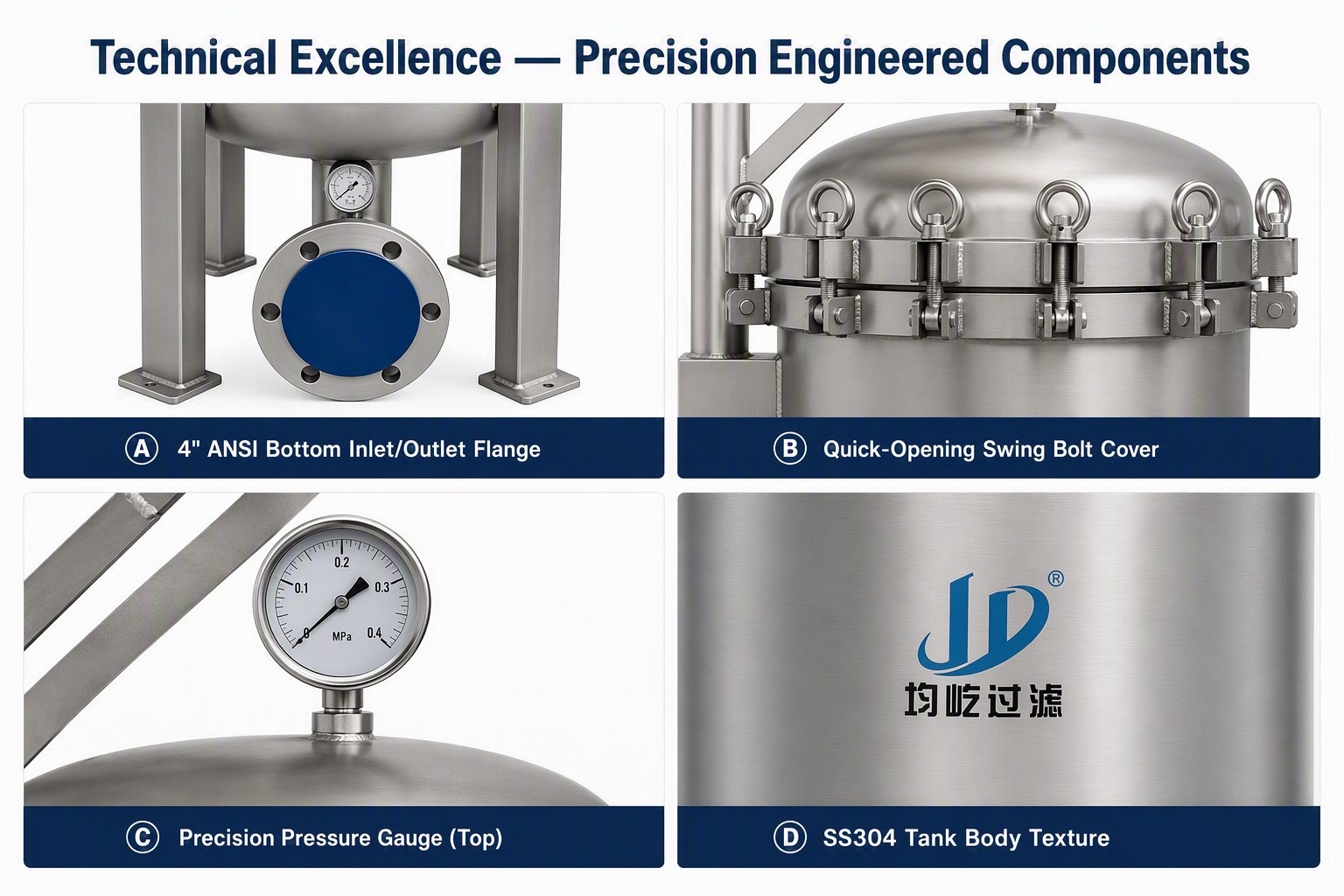
After discussing the pipeline layout and flow data with the client, our technical team recommended the JYMF-4P/304 type stainless steel multi-bag filter to the customer. This equipment is made of SS304 stainless steel and is equipped with 4 PE material 100-micron filter bags, which increase the total filtration area by 4 times compared to the original single-bag system. The 4″ ANSI standard flange is fully compatible with the client’s existing bottom-in-bottom-out pipeline, eliminating the need to modify the main pipeline. The nitrile rubber sealing ring can withstand oil-containing fluids within 100°C, fully meeting the customer’s 85°C working condition requirements.
During the installation process, the old equipment was dismantled and the new equipment was connected in just half a day. The sandblasted stainless steel shell is not only corrosion-resistant but also easy to clean and wipe daily. During the equipment debugging stage, we set the working pressure to 85 PSI (much lower than the equipment’s maximum working pressure of 100 PSI), ensuring sufficient safety margin.
Implementation effect
After the equipment was put into use, the client recorded the operation data of a complete production cycle, and the results were remarkable:
Filter efficiency improvement: The four-bag parallel structure extended the single-use duration of the filter bags from the original 2.5 hours to over 10 hours, and the single-day filter bag replacement frequency decreased from 8 times to 2 times, significantly reducing the labor intensity of the operators.
Product quality stability: The pressure difference growth curve became more stable, the downstream product turbidity fluctuation range narrowed, and the internal inspection pass rate of the client increased from 92.5% to 99.1%, with no more quality complaints about clarity in the past two months.
Maintenance cost reduction: Due to the reduced filter bag replacement frequency, the monthly consumption cost of auxiliary materials (filter bags) decreased by approximately 62%; meanwhile, the nitrile rubber sealing ring remained in good elasticity after being checked for three consecutive months, without any leakage.
Production line comprehensive efficiency: The single-batch production time was reduced from the original 16 hours to 11.5 hours, and under the same monthly order volume, the equipment operation days were reduced by 4 days, releasing space for equipment maintenance and capacity allocation for the client.
Customer feedback
The production manager of the enterprise mentioned at the project summary meeting: “This four-bag filter not only solved our most troublesome pressure difference problem, but more importantly, the bottom-in-bottom-out connection method enabled us to complete the upgrade almost without moving the pipeline. Now, the filter bag replacement only takes about ten minutes, and the sandblasted surface does not accumulate material, making cleaning very convenient. For production lines that pursue stable production, this equipment is well worth the price.”
Summary
For many small and medium-sized chemical, coating or food ingredient enterprises that are facing filtration bottlenecks, upgrading from single-bag to multi-bag filters is not merely a matter of adding more bags; it represents a qualitative change in system stability. In this case, the JYMF-4P/304, with its reasonable material selection, precise accuracy matching, and simple installation interface, helps the customer achieve a smooth upgrade of the filtration process without interrupting the main production line, truly achieving cost reduction and efficiency improvement.
If you also have problems such as insufficient flow, excessive pressure difference, or frequent bag changes, please feel free to contact us to obtain personalized selection advice.
Post time: Aug-19-2026