

Background and Challenges
Our client is a comprehensive coatings and industrial resins manufacturer located in the United Arab Emirates. The factory has a daily production capacity of over 200 tons, and its products include building latex paint, automotive repair paint, and industrial anti-corrosion coatings. The client’s original filtration system used parallel operation of single-bag filters, with a total of 12 independent devices. This system not only occupied a large amount of workshop area but also required cleaning and verification of filter bags and cylinders for each batch of products. The entire process took up to 4 hours, severely restricting the production line switching efficiency.
The more challenging issue was the stability of quality. Due to the unpolished inner walls of the original equipment, there were microscopic weld marks and rough areas on the surface. High-viscosity resins were prone to gradually solidify and accumulate in dead corners during filtration, and occasionally falling hard particles directly led to excessive fineness in the finished products. In a batch of automotive clear coat exported to Europe, this problem was complained about by the client and required re-shipment, causing direct economic losses of approximately $120,000 and affecting the credit assessment of subsequent orders.
Solution Design and Implementation
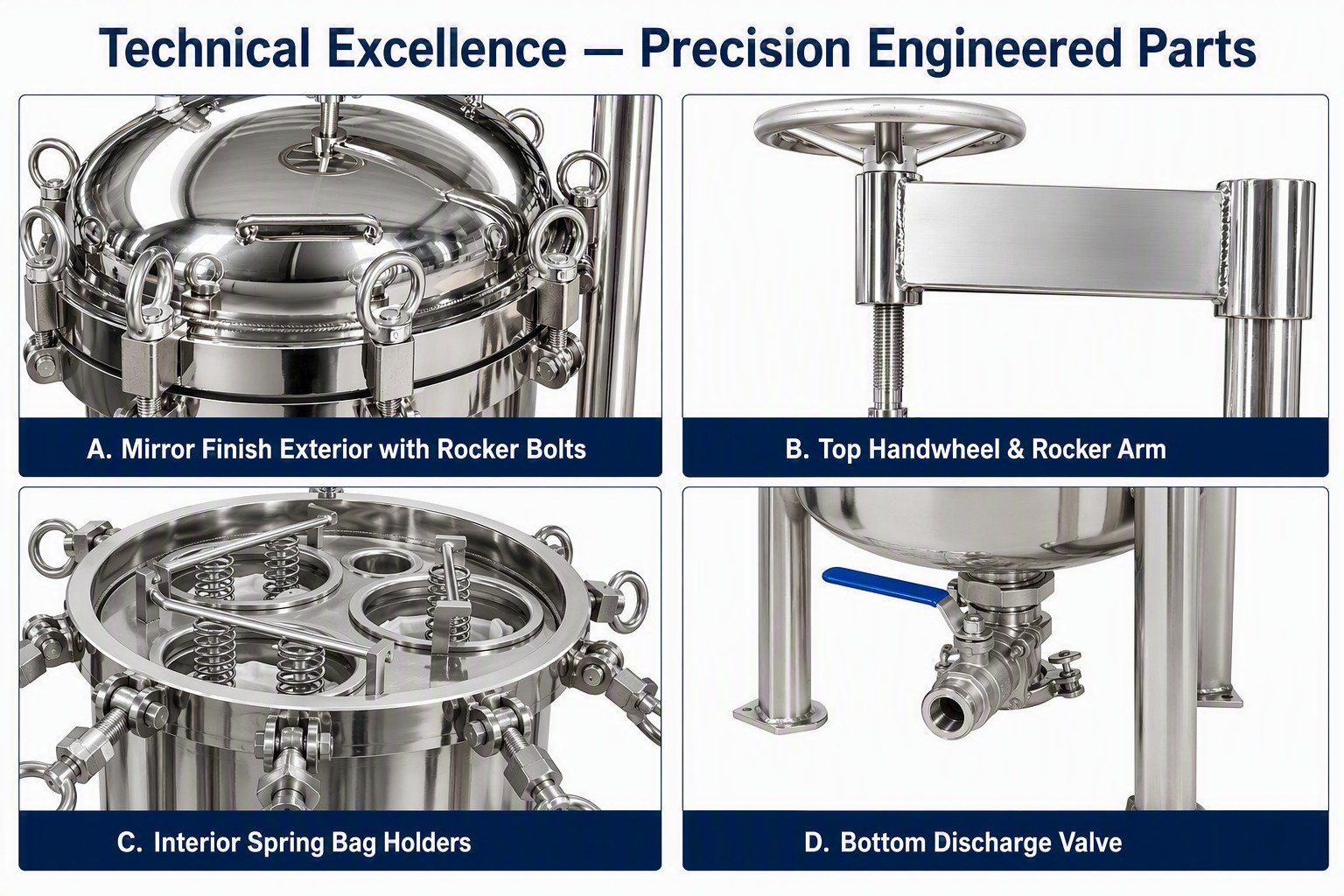
After receiving the client’s process parameters, our technical team conducted a two-week on-site survey and flow simulation. The original process required a filtration accuracy of 50 microns, a working temperature range of 80°C to 120°C, and a medium of acrylic resin system with certain corrosiveness. Based on these conditions, we customized a set of 6-bag mirror stainless steel filter units for the client. Key design details included:
The cylinder material was selected as 316L stainless steel, with all internal surfaces polished to Ra 0.3 μm. All weld seams were acid-washed and passivated before secondary grinding to eliminate any microscopic protrusions.
The inlet and outlet used a side-in, bottom-out flow direction, combined with an internal guide plate, to ensure that each filter bag was subjected to uniform flow and avoid premature increase in pressure due to uneven flow.
The top cover adopted a suspended quick-opening structure, allowing a single person to complete the overall replacement of filter bags within 3 minutes, without the need for any auxiliary tools.
An additional detachable insulation jacket was added to maintain the cylinder temperature at around 100°C, using the client’s existing hot water pipeline to prevent high-viscosity resins from cooling and solidifying on the wall.
After the equipment was manufactured, we conducted passivation verification in accordance with ASTM A967 standards and commissioned a third-party testing agency to issue surface roughness reports and hydraulic test reports, which were shipped along with the equipment. During the installation and commissioning stage, we dispatched an engineer to the site for a 5-day on-site follow-up guidance, including initial pressure difference calibration, training on filter bag installation techniques, and emergency emptying operation drills.
Implementation Results and Customer Feedback
In the first complete production month after the equipment was put into use, the client’s production records showed the following quantitative improvements:
Batch switching time: Reduced from the original 4 hours to 45 minutes, with filter bag replacement accounting for only 15 minutes, and the remaining time being for pipeline rinsing. The overall efficiency increased by approximately 81%.
Average filter bag lifespan: Thanks to the uniform flow design, the pressure difference of the filter bags rose at a significantly slower rate, and the filter capacity per batch increased from the original 8 tons to 12 tons, reducing the cost per ton of filtration materials by approximately 33%.
One-time product pass rate: After tracking 67 batches of products over three consecutive months, all fineness tests were up to standard, and there were no incidents of particle content exceeding the limit for re-shipping. The client’s quality manager specifically mentioned in an email that the mirror inner walls showed almost no residue after batch cleaning, and the verification process became “exceptionally simple and repeatable”.
The factory operations director of the client stated at the project summary meeting that this filter system not only solved the imminent quality problems but also enabled them to start re-examining the cleanliness management standards of the entire production line. Currently, the client has designated this as an internal “best practice case” and plans to continue using the same series of products in the newly built water-based coatings workshop next year.
Post time: Aug-20-2026