

Project Background
Southeast Asia is a major global producer of palm oil. With increasingly stringent environmental regulations and a growing emphasis on the value of by-products, the treatment of process wastewater and dewatering of fibrous fruit residue during palm oil processing have become industry focal points. The customer is a medium-sized palm oil pressing mill with a daily processing capacity of approximately 300 tons of fresh fruit bunches. For a long time, the mill relied on a traditional plate-and-frame filter press for process water purification and residue dewatering. However, the old equipment suffered from the following issues:
-
Excessively long discharge time: The plate-by-plate unloading design resulted in each discharge cycle taking nearly 40 minutes, severely constraining the turnover efficiency of the downstream wastewater treatment system.
-
High moisture content in filter cake: Relying solely on gravity filtration without an air-drying function, the filter cake maintained a moisture content between 38% and 42%. This led to high off-site landfill costs, and the leachate easily caused secondary pollution.
-
Severe contamination in the collection area: The open discharge hopper caused wet residue to scatter across the floor, requiring frequent manual cleaning. Meanwhile, filtrate splashes corroded the surrounding steel structures.
-
Unstable hydraulic system: The old equipment had insufficient hydraulic pressure-holding capacity, frequently causing pressure drop and material spray, which compromised production continuity.
Solution
After communication, our technical team provided the following customized configuration based on the characteristics of the palm oil process wastewater (oil content approx. 2%–3%, solids content 4%–6%):
-
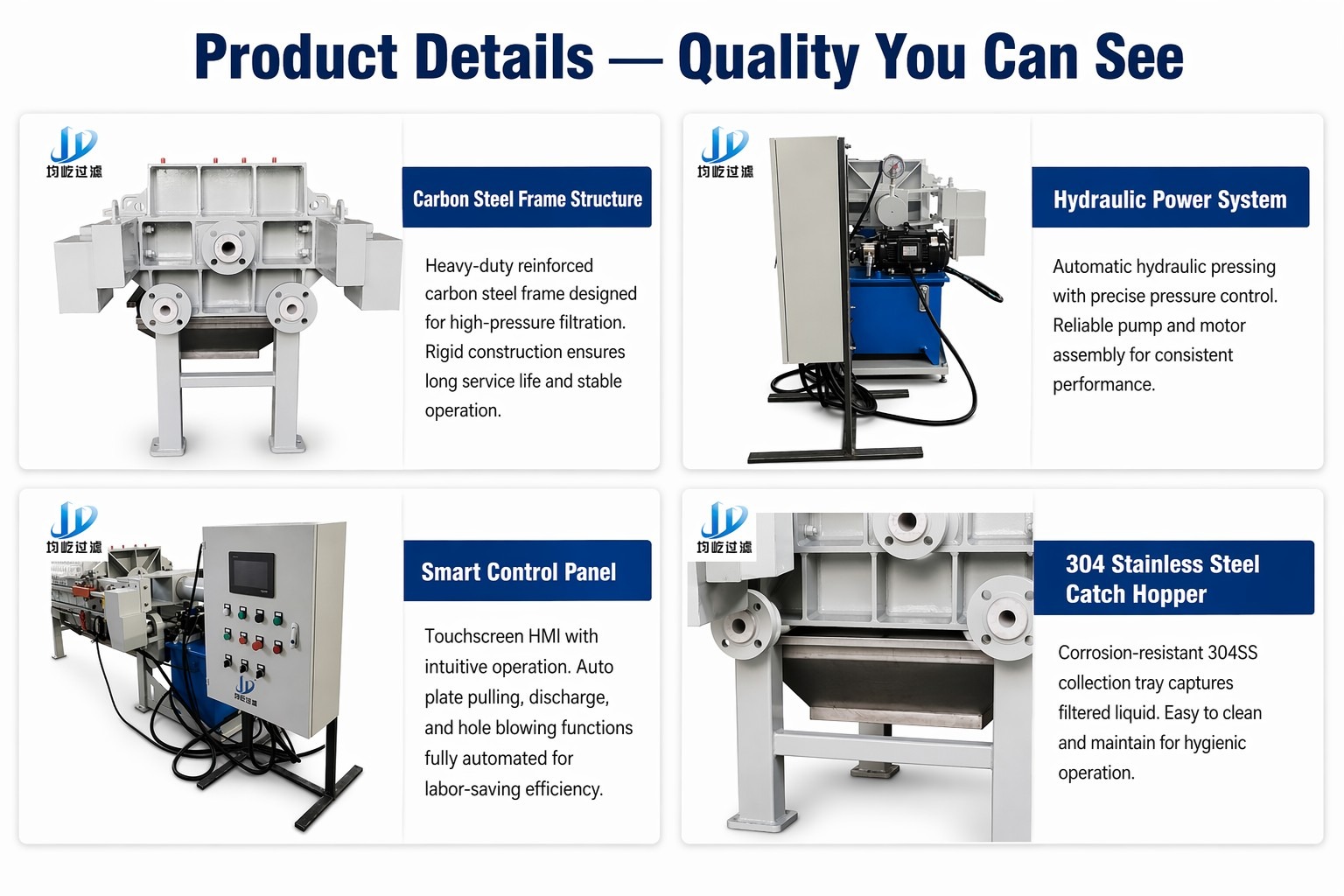
Model selection: The XAZ6/450-30 was chosen, with a carbon steel frame to withstand high-frequency operation intensity. The center-feed inlet design effectively ensures uniform filling of fibrous materials, preventing flow deviation in the filter chambers.
-
Dual dark-flow system: The original open bright-flow system was converted to a center-feed inlet with dual dark-flow outlet. The filtrate is fully enclosed and conveyed to a clarification pond for reuse. This not only eliminated splashing but also protected operators from the risk of scalding by high-temperature filtrate.
-
Simultaneous plate shifting + automatic air blowing: To meet the customer’s strict requirements for discharge time, we adopted a one-time simultaneous opening of all filter plates, combined with 0.6 MPa high-pressure air back-blowing. This reduced the filter cake moisture content from above 40% to 28%–30%.
-
304 stainless steel discharge hopper: All parts in contact with wet residue were made of 304 stainless steel, which is resistant to fruit acid corrosion and features a smooth, non-stick surface. Paired with a bottom screw conveyor, this enables automatic loading of wet residue.
Implementation Results
The equipment was installed and commissioned in March 2025. After four consecutive months of full-load operation (20 hours per day, two shifts), significant improvements were achieved:
-
Efficiency leap: The time for a single complete cycle (clamping → feeding → filtration → air blowing → unclamping → one-time plate shifting and discharge) was reduced from the original 95 minutes to 52 minutes. Daily processing batches increased from 15 to 23, representing an overall solid-liquid separation capacity increase of approximately 53%.
-
Optimized filter cake quality: After air drying, the filter cake moisture content stabilized at around 29%, with a notably higher calorific value. The customer now sells the dried filter cake as biomass fuel to a local power plant, earning an additional USD 22 per ton compared to wet residue—turning waste into a valuable revenue stream.
-
Significantly improved operating environment: The dual dark-flow system eliminated filtrate splashing, and the 304 stainless steel hopper left no residue dead zones. The workshop floor remained dry and clean, and workers reported a marked reduction in labor intensity, no longer needing to spend 1.5 hours per shift on floor washing.
-
Validated equipment reliability: The carbon steel frame showed no significant corrosion in the tropical high-humidity environment (with regular oiling maintenance). The hydraulic system maintained accurate pressure, and after more than 5,000 cumulative cycles, no material spray or filter plate damage occurred.
-
Energy consumption comparison: Although the air compressor for air blowing added energy use, the reduced filtration cycle shortened the total operating time of the feed pump. Overall electricity consumption decreased by approximately 12% compared to the old equipment.
Customer Feedback
The project manager commented: “The stability and automation level of this XAZ6/450-30 have exceeded our expectations. The time saved by the one-time plate shifting allows us to better balance the pace between the upstream pressing workshop and the downstream wastewater treatment. What impressed us most is the dried filter cake produced by the air-blowing system—it has turned from a waste that required disposal costs into a marketable product. We are already planning to purchase a second unit of the same model.”
Case Summary
This case fully validates the adaptability of the XAZ6/450-30 fully automatic hydraulic filter press for treating fiber-containing, oil-bearing organic slurries. The complete configuration—incorporating automatic hydraulic clamping, center feeding, dual dark-flow outlets, one-time plate shifting, automatic air blowing, and a 304 stainless steel discharge hopper—not only addressed the customer’s core needs regarding capacity, environmental protection, and operational safety but also delivered added value by reducing filter cake moisture and enabling resource utilization. This successful practice has attracted considerable attention in the local palm oil processing industry, with three similar companies already consulting our team for comparable solutions.
Post time: Jul-24-2026