

I. Project Background
Vietnam, as a global hub for cassava starch production and export, hosts numerous small- to medium-sized cassava starch processing plants that traditionally rely on centrifugal screens for pre-treatment of cassava pulp. The client in this project is a large-scale domestic cassava starch manufacturer in Vietnam. Their existing production line has long used bulky centrifugal filtration equipment at the front end of hydrocyclones to remove impurities from cassava milk.
Over time, the client identified several critical issues with traditional centrifugal systems: large footprint and high space consumption, limiting layout flexibility; high energy consumption and significant operational noise, increasing electricity costs; complex structure with high-speed wear-prone components, leading to frequent maintenance and unplanned downtime; and unstable filtration accuracy, failing to effectively capture coarse fibers, debris, or clumped raw materials in the cassava pulp. This results in frequent clogging and wear of downstream hydrocyclones, significantly reducing starch purification efficiency and product quality, while increasing maintenance costs for subsequent equipment.
To optimize production processes, reduce energy and maintenance expenses, and stabilize product quality, the client decided to phase out outdated centrifugal units and procure a new, efficient, energy-saving, compact filtration system specifically designed for pre-treatment before hydrocyclones—capable of precisely removing all foreign contaminants from cassava milk.
II. Site Conditions and Core Technical Requirements
Our technical team conducted an on-site assessment of the client’s production line, analyzing pipeline specifications, flow rates, pressure conditions, and filtration requirements to define precise equipment parameters. All specifications were fully compatible with the existing production line, eliminating the need for pipeline modifications and enabling direct installation:
• Processing medium: Cassava pulp (cassava milk)
• Installation location: Pre-treatment stage prior to hydrocyclone
• Existing pipe size: 76 mm stainless steel piping
• Rated flow rate: 20 m³/h
• Feed pressure: 3–6 Bar
• Inlet and outlet size: DN65
• Filtration precision requirement: 420 microns, effectively capturing coarse fibers, particulate impurities, and clumped raw materials
• Material requirement: 304 stainless steel, meeting food-grade standards, corrosion-resistant, non-rusting, and contamination-free
• Core equipment requirement: Dual-basket filter supporting continuous operation without shutdown, ensuring uninterrupted production, while achieving compact design and low energy consumption to replace traditional heavy centrifugal equipment
III. Customized Equipment Solution
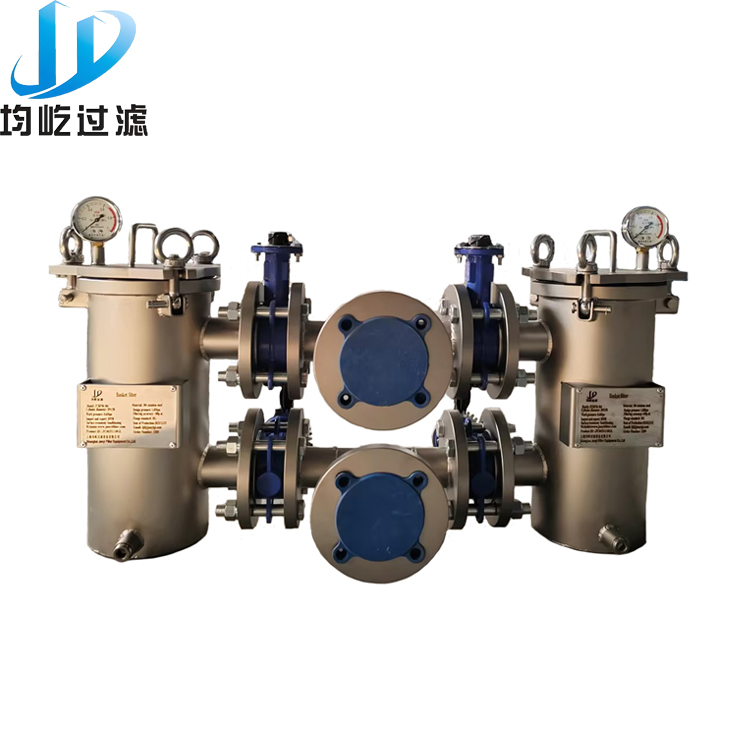
Based on the client’s production challenges and precise site conditions, we customized a dual-basket filter made of 304 stainless steel, perfectly suited for cassava starch pulp pre-treatment. This solution replaces conventional centrifugal filters, delivering superior filtration accuracy, continuous production capability, energy efficiency, and space optimization. Key configurations and features include:
1. Material Compatibility: The entire unit is constructed from food-grade 304 stainless steel. Flow-through components—including filter mesh, housing, and inlet/outlet pipes—are designed without dead zones, offering excellent resistance to weak acid corrosion, high temperatures, and scaling. Suitable for Southeast Asia’s humid and tropical environment, it prevents raw material contamination and meets food safety standards for starch production, significantly extending equipment service life.
2. Precise Parameter Matching: The unit is custom-built with DN65 inlet and outlet ports, seamlessly connecting to the existing 76 mm stainless steel piping without requiring modifications, ensuring quick and easy installation. It comes standard with a 420-micron high-precision stainless steel woven mesh capable of efficiently capturing coarse fibers, sediment, clumps, and other contaminants in cassava milk, thoroughly purifying the feedstock entering the hydrocyclone. With a rated flow capacity of 20 m³/h, the system operates stably under 3–6 Bar working pressure, free from backpressure, leakage, or flow degradation. 3. Dual-basket continuous operation design: Featuring a parallel dual-cylinder structure with a manual switching valve, the system enables single-cylinder filtration and offline cleaning or replacement during production without stopping operations. This eliminates the downtime issues associated with single-cylinder filters and fully meets the 24/7 continuous starch production requirements of factories, ensuring efficient and uninterrupted line operation.
4. Lightweight and energy-efficient upgrade: Compared to traditional centrifugal screens, the dual-basket filter lacks high-speed motors and complex transmission mechanisms. Its compact size significantly reduces footprint, saving substantial workshop space. The equipment consumes almost no operational energy—relying solely on pipeline pressure for natural filtration—effectively resolving the problems of high power consumption, excessive wear, and noise common in conventional centrifugal systems. This reduces both production energy use and maintenance costs at the source.
IV. Project Implementation and Application Results
After delivery, the technical team assisted the client with on-site installation, commissioning, and operator training. The equipment achieved full performance standards upon initial startup and was successfully integrated into the pre-treatment stage before the hydrocyclone in the cassava starch production line. It has operated stably, delivering significant optimization results and effectively addressing the client’s previous production challenges:
1. Dramatic improvement in filtration quality and extended downstream equipment lifespan: The 420-micron high-precision filter screen efficiently captures all types of impurities and foreign matter from the cassava slurry. As a result, the purity of the slurry entering the hydrocyclone is significantly enhanced, effectively preventing internal clogging, wear, and scaling within the cyclone. This greatly reduces failure rates and maintenance frequency of downstream core equipment, stabilizes the starch purification process, and improves both the purity and pass rate of finished cassava starch.
2. Remarkable cost reduction and efficiency gains: Successfully replacing high-energy-consumption, large-volume traditional centrifugal equipment, the new system reduces operating energy consumption by over 90%, saving the factory substantial electricity costs annually. With its simple structure and absence of vulnerable moving parts, the equipment is easy to clean and maintain, requiring no specialized personnel or complex operations—greatly lowering labor and maintenance costs as well as production downtime.
3. Full assurance of production continuity: The dual-basket switching design allows for seamless cleaning and filter replacement without halting operations, completely eliminating stoppages in the pre-treatment process. This significantly enhances continuous production efficiency and meets the demands of large-scale manufacturing.
4. Optimized workshop layout: Thanks to its lightweight and compact design, the equipment occupies minimal floor space, solving the problem of space congestion caused by traditional centrifugal units. This optimizes workshop layout, improving overall cleanliness and operational convenience.
V. Customer Feedback and Project Summary
This project addressed the key pain points of traditional pre-treatment equipment at a Vietnamese cassava starch plant by providing a customized dual-basket filtration solution tailored to precise operating conditions. Leveraging core advantages such as low energy consumption, high precision, minimal maintenance, continuous operation, and space-saving design, the solution successfully replaced conventional centrifugal filtration systems. Since commissioning, the production line has seen significant improvements in stability, product quality, and efficiency, along with substantial reductions in energy and maintenance costs, delivering tangible economic benefits to the client.
The customer highly praised the equipment’s compatibility, filtration performance, energy efficiency, and installation support. This unit has become the preferred choice for upgrading pre-treatment processes in medium- and small-scale cassava starch production lines in Vietnam, offering a proven reference for process optimization and energy-saving upgrades across Southeast Asia’s cassava processing industry.
Post time: Jul-01-2026