

In a large chemical industrial park in Southeast Asia, a manufacturing enterprise specializing in the production of fine chemicals and industrial coatings has long been facing the problem of low efficiency in intercepting fluid impurities during the production process. The enterprise’s original single-bag filter equipment, when dealing with high-viscosity and high-flow resin and solvent mixtures, not only saw an extremely rapid increase in pressure drop but also required several hours of downtime for replacing the filter bags, using various tools to dismantle the heavy cover, severely restricting the continuous operation efficiency of the production line. What was even more challenging was that due to the aging sealing structure of the original equipment, leakage around the filter bag edges occurred frequently, resulting in substandard fineness of downstream products and frequent customer complaints and rework.
To completely solve this bottleneck, the enterprise’s process engineering team, after inspecting several international filter equipment suppliers, decided to introduce a batch of new mirror-steel multi-bag filters for production line upgrade. The core reason for their decision was the three core advantages of this equipment for industrial fluid processing scenarios.
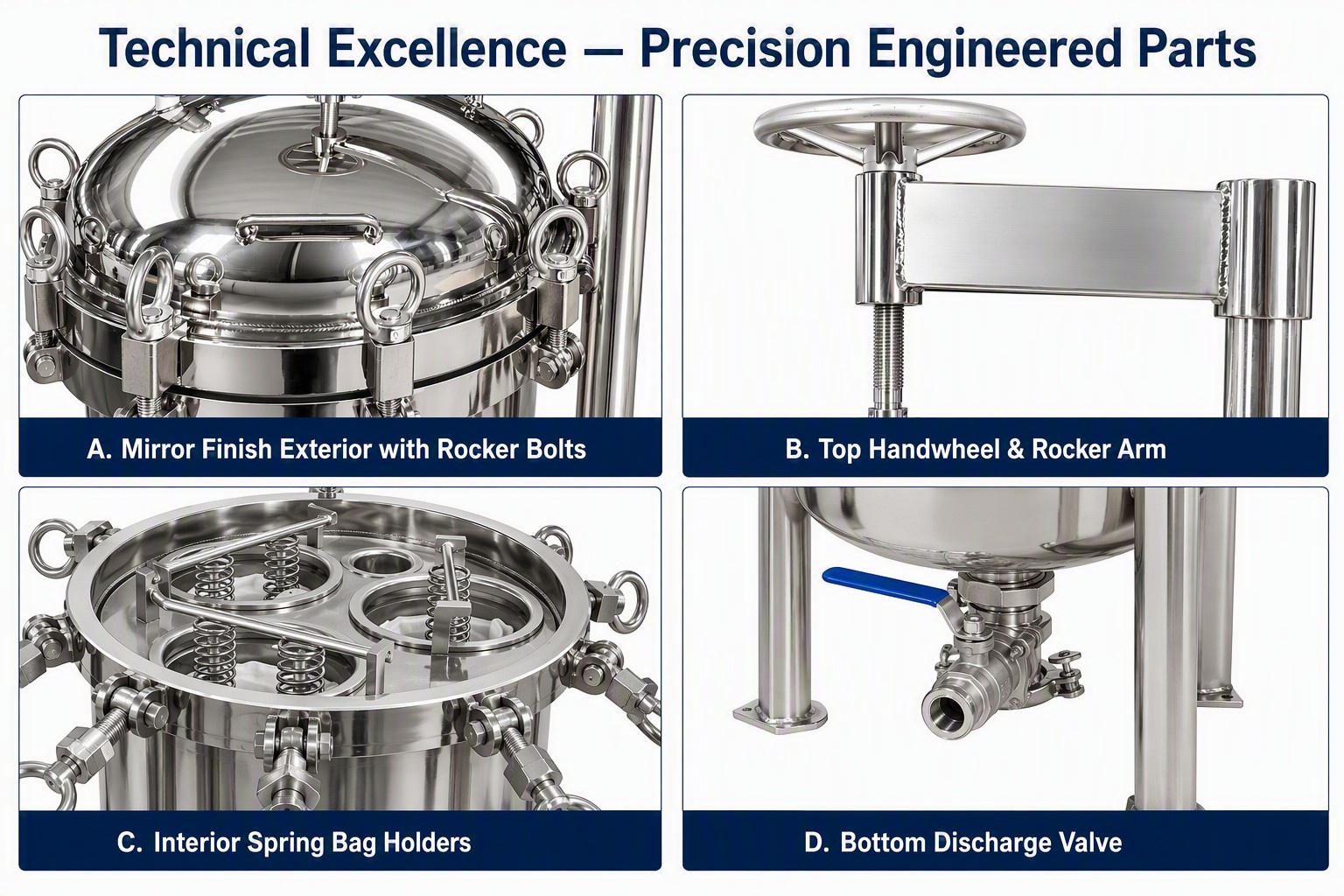
Firstly, what completely changed the maintenance experience was its innovative quick-opening rocker arm and handwheel system. During the actual installation and commissioning stage, the enterprise’s maintenance personnel found that the filter cover, which previously required tools such as wrenches and screwdrivers to open, now only needed one operator to manually rotate the top handwheel, leveraging the lever action of the rocker arm, to easily complete the opening and locking within tens of seconds. This tool-free quick-opening design compressed the downtime for replacing the filter bags to less than ten minutes, significantly enhancing the effective operation rate of the production line.
Secondly, to address the leakage problem that had long plagued the enterprise, the internal heavy multi-bag support frame and precise spring compression structure of the new filter provided a perfect solution. When the fluid entered the filter at a high flow rate, the internal spring compression device could ensure that the opening edge of each filter bag was tightly adhered to the support plate, forming a reliable seal. This zero-leakage structural design ensured that all fluids must pass through the filter medium of the filter bag, thereby ensuring the absolute stability of the interception accuracy. After a period of operation monitoring, the particle residue of the enterprise’s downstream products significantly decreased, and the consistency of product batches was greatly improved.
Furthermore, the mirror-polished surface treatment on the inside and outside of the equipment left a deep impression on the equipment maintenance team of the chemical enterprise. When handling corrosive chemical solvents, the mirror-steel surface not only demonstrated outstanding corrosion resistance, extending the service life of the equipment in harsh conditions, but also its smooth and seamless surface characteristics made daily rinsing and cleaning extremely easy, effectively avoiding the risk of cross-contamination between different batches of materials.
The enterprise’s production director summarized this equipment upgrade, stating that introducing this multi-bag filter was not merely replacing an old equipment, but a redefinition of the entire fluid purification process. From the time-saving benefits of quick opening to the quality guarantee brought by the spring compression, and to the long-term durability brought by mirror-steel anti-corrosion, this equipment has delivered an impressive performance in improving production efficiency and reducing overall maintenance costs.
Post time: Sep-30-2026