

Case Study: Manual Hydraulic Filter Press for Alkaline Herbal Extract Processing in Southeast Asia
1. Background & Challenges
A plant extract facility in Southeast Asia specializes in producing herbal extracts for the food and natural cosmetics industries. The factory processes large volumes of alkaline herbal extracts (pH 9–11) daily and must efficiently remove plant residues while recovering active ingredients from the liquid phase.
However, the original process faced several critical issues:
-
Slow sedimentation: Natural solid-liquid separation took 4–6 hours per batch, severely limiting production throughput.
-
High moisture in sludge: Residual sludge contained about 85% moisture, leading to significant loss of active ingredients.
-
Low raw material utilization: Only about 75% of active components were recovered; the rest were discarded with the residue.
-
Unstable power supply: Frequent power outages in the region made electric-dependent equipment unreliable.
-
Small batch size: Large, fixed filtration systems were not suitable; a flexible, compact solution was needed.
2. Selected Solution: XMQ2/380 Manual Hydraulic Plate Filter Press
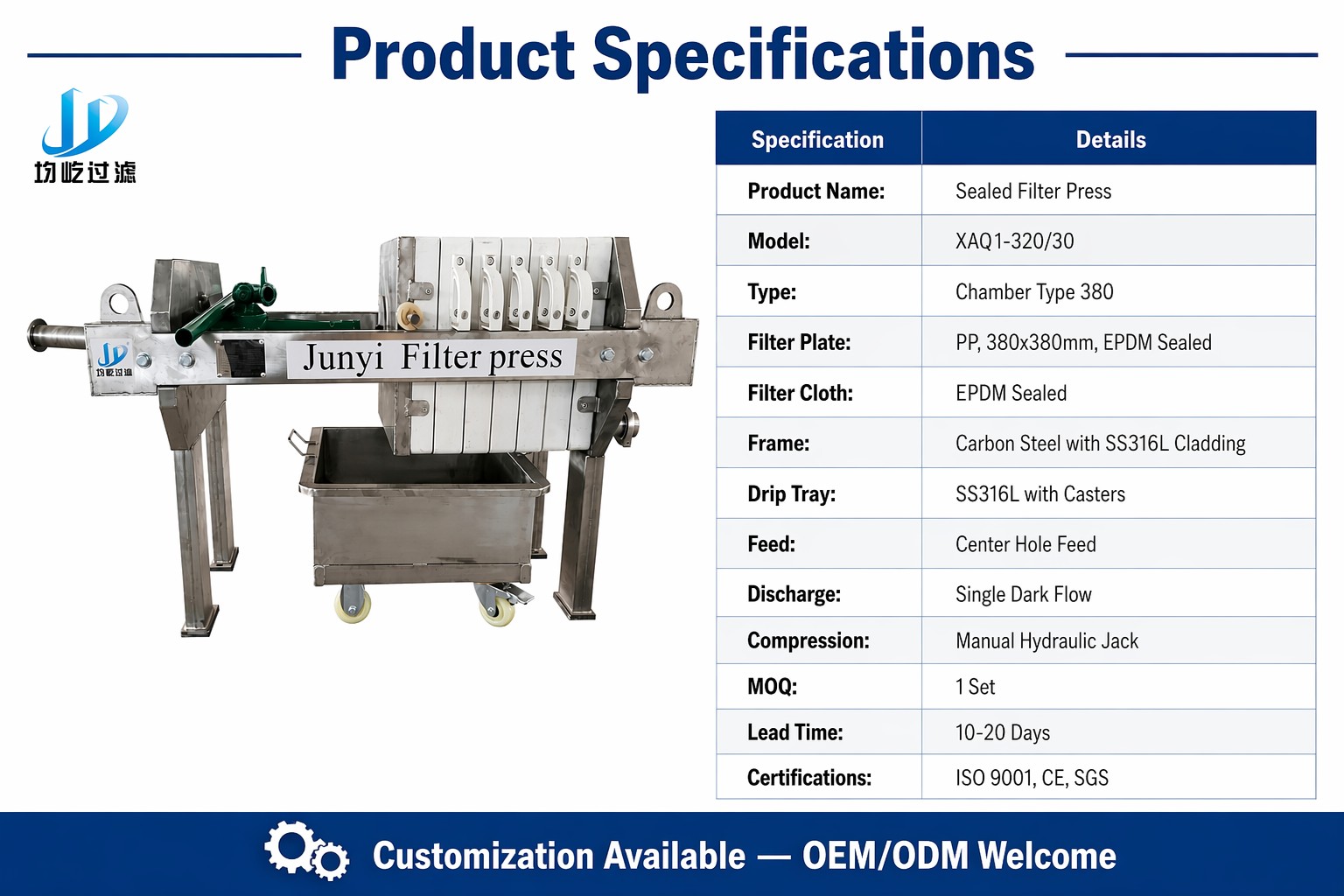
To address these constraints, the factory chose the XMQ2/380 manual hydraulic filter press, which offers:
-
No electricity required: Powered entirely by a manual hydraulic jack, ensuring stable pressing force even during power outages.
-
Compact filtration area: 2 m² filtration area perfectly matches small-batch production, avoiding overcapacity.
-
Box-type filter plates with single-channel liquid discharge: Allows direct visual inspection of filtrate clarity and timely detection of abnormalities.
-
Corrosion-resistant materials: Equipped with PP pneumatic diaphragm pumps and 304 stainless steel pipelines, suitable for alkaline liquids.
-
Mobile design: Built-in wheels enable easy movement across the workshop, supporting multi-purpose use with a single machine.
3. Performance Improvements After Implementation
After putting the equipment into use, the factory achieved remarkable results:
| Metric | Before (Natural Sedimentation) | After (Filter Press) | Improvement |
|---|---|---|---|
| Active ingredient recovery rate | ~75% | ~94% | +19 percentage points |
| Filtration time per batch | 4–6 hours | 1.5–2 hours | Reduced by >60% |
| Residual moisture in sludge | ~85% | ~68% | Reduced by ~17 percentage points |
| Raw material utilization | Low (significant waste) | Greatly improved | Significant reduction in active ingredient loss |
4. Feedback from Production Supervisor
“This small manual filter press has fully met our expectations. It is very simple to operate, requires no electrician intervention, and is easy to move around. The filtered liquid is extremely clear. Most importantly, it helps us recover more valuable components and reduces raw material waste.”
5. Conclusion & Value Proposition
This case clearly demonstrates the unique advantages of the manual hydraulic filter press under special working conditions:
-
Achieves efficient solid-liquid separation using purely mechanical compression, independent of stable power supply.
-
Significantly boosts production efficiency and raw material utilization.
-
Keeps equipment investment and maintenance costs low.
-
Provides a replicable, cost-effective solution for similar solid-liquid separation needs in plant extraction, food processing, and related industries—especially in regions with unreliable electricity.
Post time: Jul-29-2026