

Customer Background
A certain fine chemical manufacturing enterprise in Southeast Asia mainly produces industrial coatings, resins and adhesives, with an annual production capacity of approximately 150,000 tons. Previously, this enterprise had been using single-bag filters connected in series and operating in parallel. However, with the expansion of production capacity and the increase in product quality requirements, the original filtration scheme gradually revealed many problems: frequent filter bag replacements, long maintenance time, complex pipeline systems resulting in high pressure loss, and occasional sealing leaks affecting product purity.
The Challenges Faced
This client is confronted with four major core problems during the production process.
First, the maintenance costs remain high. The production line needs to operate 6 single-bag filters simultaneously. The replacement cycle of each filter bag varies, and workers need to frequently stop the machine for inspection. On average, it takes about 8 hours per week to carry out the filter bag replacement operation, which seriously affects the operational efficiency of the production line.
Second, the space layout is limited. The original 6 single-bag filters were installed in parallel, occupying approximately 4 square meters of floor space. The pipelines were crisscrossed, which not only affected the appearance of the workshop but also increased the difficulty of daily cleaning and inspection.
Third, the sealing performance is insufficient. Some filter sealing components exhibit minor leakage during the middle stage of their service life. For high-value resin products, the presence of trace impurities can lead to the degradation of the entire batch of products, resulting in significant economic losses.
Fourth, the processing capacity has reached a bottleneck. As the production line was accelerated to a flow rate of 180 cubic meters per hour, the total filtration area and throughput of the original single-bag series-connected system could no longer stably meet the requirements. The pressure difference rose too rapidly, and frequent shutdowns were necessary to replace the filter bags.
Solution
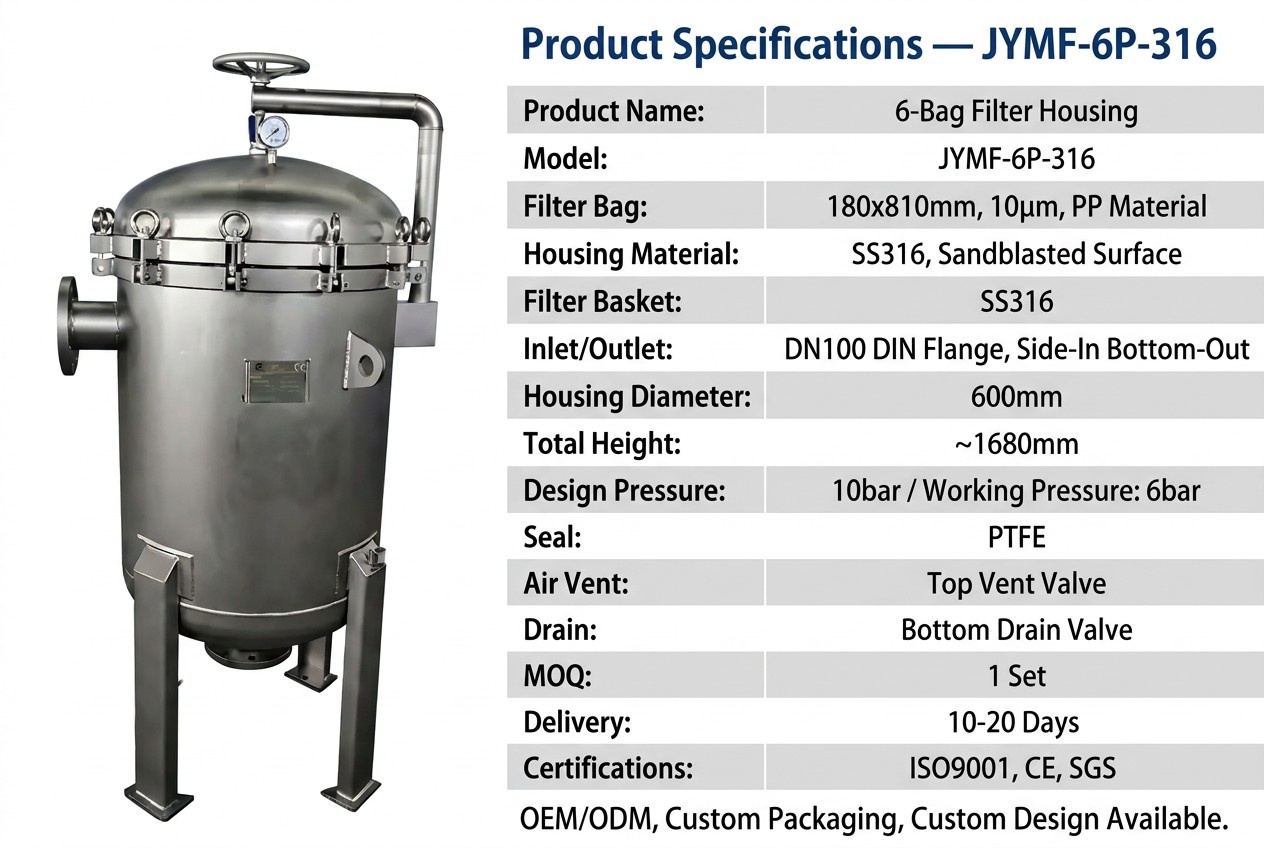
After comparing with several suppliers, this customer finally chose the JYMF-6P-316 type 6-bag high-throughput filter. Each device is equipped with 6 No. 2 standard filter bags, with a filtration accuracy of 10 microns. The filter bags are made of PP material and are combined with PTFE sealing rings. The specific application plan is as follows.
One JYMF-6P-316 filter is installed at the rear section of the resin synthesis reactor and before the finished product filling process. Each filter is responsible for coarse filtration and fine filtration respectively. With the design of side inlet and bottom outlet flow, the original pipeline system only needs a simple modification to be compatible. The equipment uses an SS316 material cylinder and filter basket, with sandblasted surface treatment to ensure no corrosion risk when in contact with weakly acidic paint solvents for a long time.
Implementation Effect
Six months after the equipment was put into operation, the customer’s production department provided the following improvement results.
In terms of floor area, it decreased from approximately 4 square meters before improvement to about 1.2 square meters after improvement, saving over two-thirds of the space. In terms of weekly maintenance time, it was shortened from 8 hours before improvement to 2.5 hours, resulting in a significant improvement in labor efficiency. In terms of the average lifespan of filter bags, due to more uniform flow rate distribution, it was extended from 72 hours before improvement to 120 hours, resulting in a significant reduction in material costs. In terms of the rate of pressure increase, it was reduced by approximately 40% compared to before improvement, making the filtration system operate more stably. In terms of sealing leakage incidents, before improvement, there were an average of 1.2 leakage incidents per month, but since the improvement was implemented and up to now, there have been no leakage incidents, achieving a qualitative improvement in reliability.
During the peak production period, a single JYMF-6P-316 unit alone was sufficient to handle the normal flow demand of 180 cubic meters per hour. Another unit was used as a backup and in series with the primary unit for fine filtration. The overall filtration efficiency was significantly improved compared to the previous solution. The production manager of the client stated that the new solution not only significantly reduced the cost of consumables and the intensity of manual maintenance, but more importantly, the consistency of product batches was significantly improved, and the customer complaint rate decreased by approximately 30% within half a year.
Customer Review
The production manager of the enterprise concluded during the follow-up visit that integrating 6 scattered small machines into two large-capacity equipment was not merely a reduction in quantity. The SS316 material of JYMF-6P-316 gave them the flexibility to handle various formula products, and the PTFE seal completely solved their troublesome leakage concerns. This equipment was the most cost-effective investment in their production line upgrade.
Summary
The successful application of the JYMF-6P-316 multi-bag filter in this chemical enterprise demonstrates that for processes involving medium to high flow rates, medium viscosity liquids, and clear requirements for filtration accuracy and corrosion resistance, the centralized multi-bag filtration solution offers significant overall cost advantages over the decentralized single-bag parallel system. Its compact design, stable sealing performance, and the wide media adaptability brought by the SS316 material make it an ideal choice for upgrading production lines and new projects in the chemical industry.
Post time: Jul-23-2026