

Project Background
The customer is a well-known domestic steel producer with multiple hot rolling and cold rolling lines across its plant site. The associated circulating cooling water system has a total treatment capacity of several thousand cubic meters per hour. Prior to the retrofit, the customer had been using traditional basket strainers for coarse filtration of the circulating water. However, due to the large amounts of iron oxide scale, welding slag, and pipe rust debris present in the water, the basket strainers required manual disassembly and cleaning every 4 to 6 hours on average. This not only consumed significant manpower but also caused fluctuations in water supply pressure to the production lines due to frequent shutdowns for slag removal, severely impacting the continuity of the rolling process and the surface quality of the finished products.
Customer Pain Points
The core issues reported on-site centered on three main areas: First, the excessively high frequency of filter clogging—during night shifts, there was often no one available to remove slag, resulting in reduced cooling water flow and diminished heat exchanger efficiency. Second, each disassembly and cleaning required draining the pipeline medium, resulting in considerable water loss and energy waste per cleaning cycle. Third, the basket strainer elements were made of a single-layer perforated plate structure, where large particles became lodged in the mesh holes and were difficult to remove completely; after repeated use, filtration performance continued to deteriorate.
Solution Selection
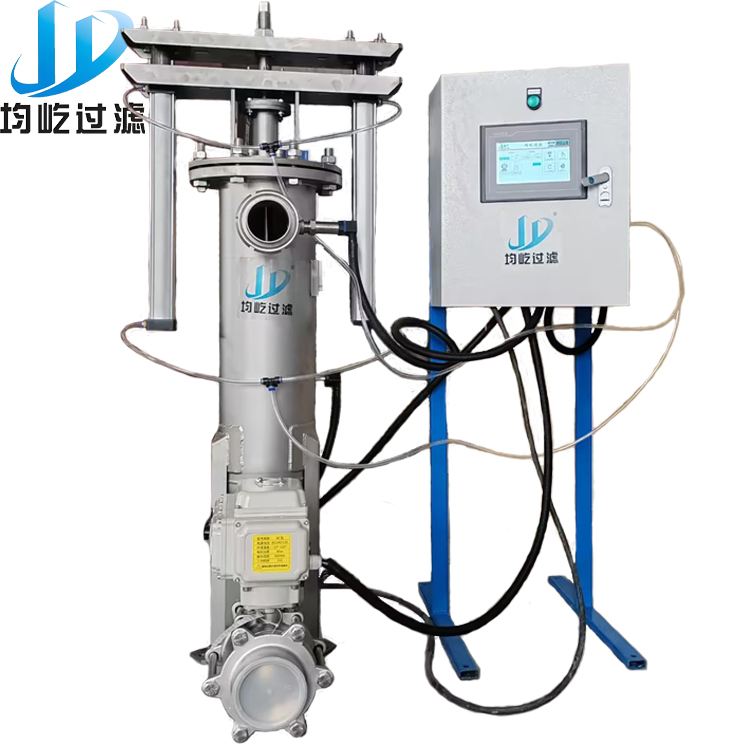
After analysis, our technical team recommended the JYSCF-219-316L pneumatic self-cleaning filter. The selection rationale included: the suspended solids in the circulating water are predominantly hard particles, making a scraper-type mechanical peeling method more suitable than backwashing; the system operating pressure is stable within the range of 0.5 to 0.6 MPa, providing sufficient cylinder drive force to meet the scraping requirements; the site has an available compressed air supply, eliminating the need for an additional hydraulic power unit or electric drive; and the existing piping uses DIN11851 quick-connect fittings, allowing the equipment to be directly matched and installed with minimal retrofitting work.
Implementation Process
The equipment was installed at the inlet of the rolling mill cooling water branch line, replacing the original basket strainer. The entire installation took only 4 hours, including removal of the old equipment, hoisting and positioning of the new unit, connection of inlet and outlet piping, installation of compressed air lines, and electrical wiring for the motorized blowdown ball valve. During commissioning, the differential pressure trigger value for cleaning was set to 0.05 MPa. The initial cylinder actuation frequency was set to automatic scraping every 6 hours, with the blowdown valve opening duration set to 8 seconds.
Operational Results
During the first month of operation, our field engineers conducted four follow-up visits. Recorded data showed that the average cleaning interval for the filter was extended from the previous manual cleaning every 4 hours to automatic actuation every 8 to 10 hours. Moreover, the amount of slag discharged during each automatic blowdown was noticeably less than the total amount previously intercepted by the basket strainer, indicating that the self-cleaning efficiency of the wedge wire screen was significantly superior to that of the perforated plate structure. The differential pressure across the cooling water system remained consistently within 0.03 MPa, and downstream plate heat exchangers no longer experienced high-temperature alarms due to insufficient water flow.
What drew even greater attention from the customer’s management was the savings in labor costs. Previously, one operator per shift was assigned full-time to cleaning strainers; after the retrofit, that position was reassigned to a roving inspection role overseeing multiple pieces of equipment. This single change freed up the daily workload of three operators. Additionally, since the cleaning process no longer required draining the pipeline, the monthly savings in water and energy consumption translated into a considerable reduction in operating costs.
Customer Feedback
The customer’s equipment manager gave a straightforward assessment during project acceptance: “The biggest problem this unit solves is not filtration precision, but stability and peace of mind. We used to dread sudden clogging alarms during night shifts and weekends—now it runs automatically with almost no intervention. The scraper has enough force to clean off even highly adhesive impurities like iron oxide scale, and the blowdown valve has never clogged.” Subsequently, the customer replicated the same retrofit solution on two additional production lines.
Post time: Jun-26-2026