

Overview
At a poultry farm in Southeast Asia, large volumes of poultry manure slurry and flushing wastewater are generated during daily operations. These materials exhibit significant fluctuations in solids content and emit noticeable odors. If discharged without proper treatment, they not only increase the load on downstream wastewater treatment systems but also pose environmental management challenges.
The farm’s existing filtration equipment had limited processing efficiency, produced filter cakes with high moisture content, and required substantial manual labor during cake discharge. To address these issues, the client decided to introduce a chamber filter press for solid-liquid separation of the manure slurry and wastewater.
Equipment Selection
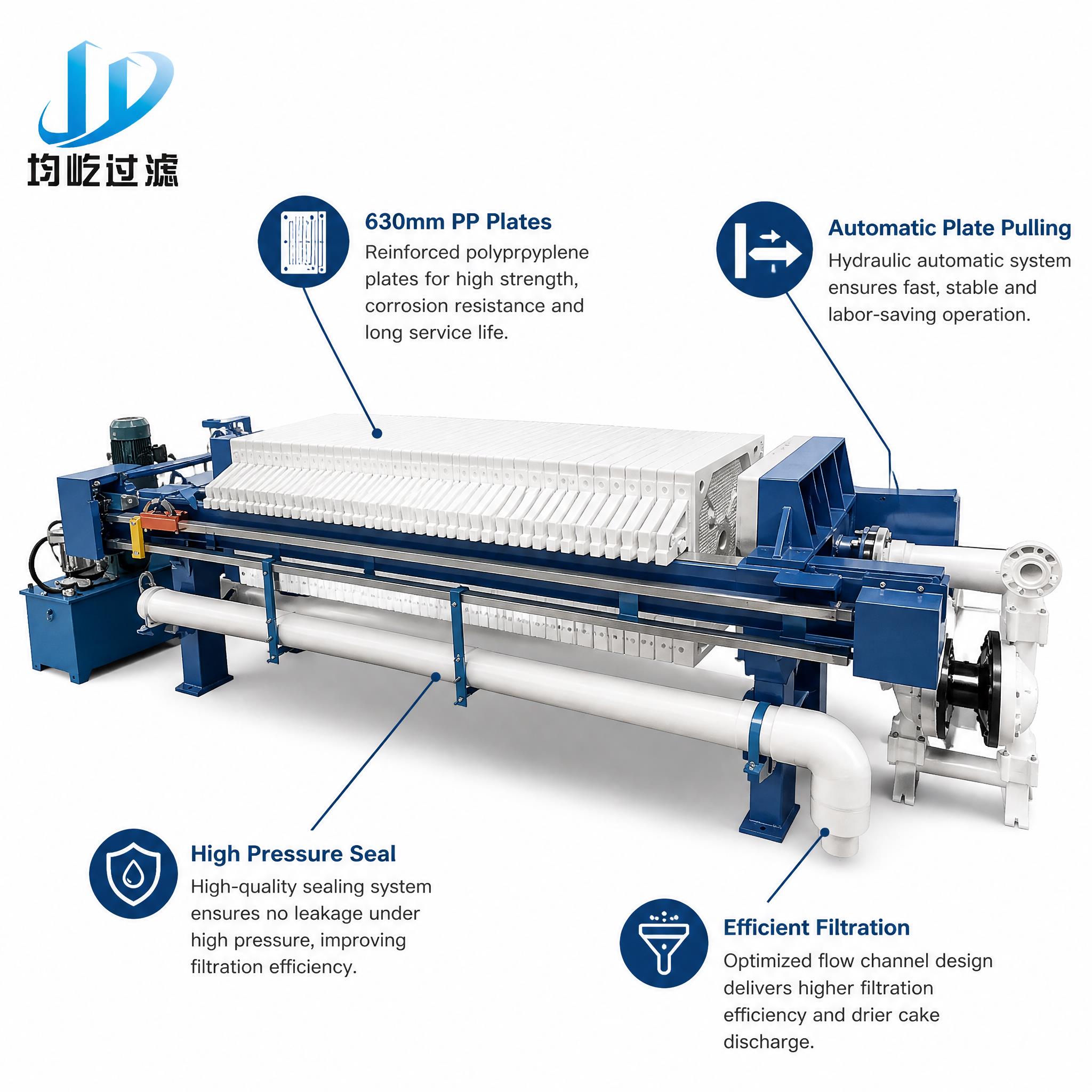
After multiple rounds of consultation and equipment selection, the client ultimately chose an XMZ35-630 chamber filter press, paired with a QBK-50-PP pneumatic diaphragm pump.
Filter Press Configuration
-
Drive: Hydraulic drive
-
Operation: Manual feeding, automatic plate pulling
-
Structure: Hydraulic chamber-type open-flow structure
-
Frame: Carbon steel
-
Design pressure: 0.8 MPa
-
Cylinder diameter: 160 mm
-
Feeding mode: Central feeding
-
Troughs: Dual open-flow plastic troughs for easy observation of filtrate discharge
-
Filter plates: PP material
-
Plate dimensions: 630 × 630 mm
-
Plate thickness: 55 mm
-
Plate configuration: 45 plates total — 43 intermediate plates and 2 end plates
-
Filter cloth: Model 750B, compatible with the 630-type plate structure
-
Hydraulic station: 220V, 50Hz single-phase power, 2.2 kW
Pump Configuration
The accompanying pneumatic diaphragm pump is also PP-constructed and connected to the filter press via PP piping, forming a complete process in which the pump feeds material directly into the filter press.
-
Model: QBK-50-PP pneumatic diaphragm pump
-
Material: PP
-
Connection: PP piping to the filter press
Operation
Once the equipment was commissioned, the farm began processing the manure slurry and wastewater in batch filtration cycles.
-
The pneumatic diaphragm pump delivers the material steadily to the filter press.
-
The hydraulic system clamps the plates together.
-
Solid-liquid separation occurs inside the filter chambers.
-
The filtrate is discharged through the dual open-flow plastic troughs.
-
The filter cake remains in the chambers.
-
After each filtration cycle, the automatic plate-pulling mechanism activates, sequentially opening the plates and allowing the filter cake to discharge by gravity.
Client Feedback
Client feedback indicates that the automatic plate-pulling function significantly reduced manual labor during cake discharge; on-site personnel only need to perform routine auxiliary cleaning and equipment inspections.
The combination of PP filter plates and the PP pneumatic diaphragm pump also proved well-suited to the characteristics of poultry manure and wastewater, with no notable corrosion issues observed during operation.
Treatment Performance
In terms of treatment performance, the chamber filter press enabled the client to achieve stable solid-liquid separation of the manure slurry and wastewater.
-
Filter cake: Easy to collect and handle for subsequent disposal
-
Filtrate: Proceeds to the next treatment stage, easing the overall load on the wastewater treatment system
The client reported that the equipment features a clear structure and intuitive operation. Manual feeding allows operators to adjust the feeding pace based on fluctuations in material concentration, while automatic plate pulling enhances discharge efficiency. The carbon steel frame provides robust structural stability and, with routine maintenance, is capable of meeting the farm’s continuous operation demands.
Conclusion
The successful operation of this project offers a reference solid-liquid separation solution for similar poultry farms and wastewater treatment applications in the region.
The combination of the XMZ35-630 chamber filter press and the QBK-50-PP pneumatic diaphragm pump is well suited for filtering and dewatering materials such as poultry manure slurry and sewage. The equipment configuration balances filtration area, operational convenience, and material adaptability, helping clients improve filtration efficiency, reduce manual discharge intensity, and create more stable conditions for downstream wastewater treatment processes.
Post time: Sep-14-2026