

High-Pressure Diaphragm Filter Press – Low Moisture Cake, Automated Sludge Dewatering

Product Introduction
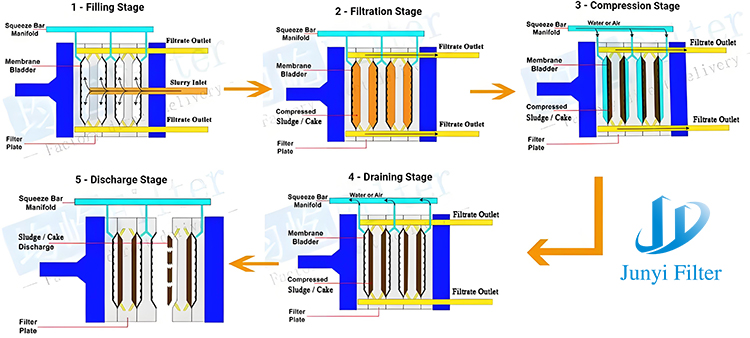
The membrane filter press is an efficient solid-liquid separation equipment.
1.Environmental protection industry (wastewater treatment and sludge dewatering)
Municipal wastewater treatment plant:
Used for concentrating and dewatering sludge (such as activated sludge, digested sludge), it can reduce the moisture content from 98% to below 60%, making it easier for subsequent incineration or landfill.
Industrial wastewater treatment:
Dewatering treatment of high-moisture and high-pollutant sludges such as electroplating sludge, dyeing sludge, and papermaking sludge.
Separation of heavy metal precipitates from wastewater in the chemical industrial park.
River/lake dredging: The silt is rapidly dehydrated, reducing transportation and disposal costs.
Advantages:
✔ Low moisture content (up to 50%-60%) reduces disposal costs
✔ Corrosion-resistant design can handle acidic and alkaline sludge
2. Mining and Metallurgy Industry
Tailings treatment:
Dewatering of tailings slurry from iron ore, copper ore, gold ore and other mineral processing, to recover water resources and reduce the land occupation of tailings ponds.
Dewatering of concentrate:
Improving the grade of the concentrate (such as lead-zinc ore, bauxite) makes it easier to transport and smelt.
Metallurgical slag treatment:
Solid-liquid separation of waste slags such as steel slag and red mud, and recovery of useful metals.
Advantages:
✔ The high-pressure extrusion results in a filter cake with a moisture content as low as 15%-25%
✔ The wear-resistant filter plates are suitable for high-hardness minerals
3. Chemical Industry
Fine Chemicals:
Washing and dehydration of powders such as pigments (Titanium Dioxide, Iron Oxide), dyes, calcium carbonate, kaolin, etc.
Fertilizers and pesticides:
Separation and drying of crystalline products (such as ammonium sulfate, urea).
Petrochemical industry:
Catalyst recovery, oil sludge treatment (such as oil sludge from oil refineries).
Advantages:
✔ Acid and alkali resistant material (PP, rubber lined steel) suitable for corrosive media
✔ Closed operation reduces toxic gas emissions
4. Food and Biotechnology Engineering
Starch Processing:
Drying and washing of corn and potato starch, using alternative centrifuges to reduce energy consumption.
Brewing industry:
Separation of yeast, amino acids, and antibiotic mycelium.
Beverage production:
Pressing and dehydration of beer mash and fruit residues.
Advantages:
✔ Made of food-grade stainless steel or PP material, meeting hygiene standards
✔ Low-temperature dehydration retains active ingredients


Related products
-

High efficiency and energy saving circulating c...
Product features of the circular filter press Compact structure, space-saving – With a circular filter plate design, it occupies a small area, is suitable for working conditions with limited space, and is also convenient for installation and maintenance. High-efficiency filtration and excellent sealing performance – The circular filter plates, in combination with the hydraulic pressing system, create a uniform high-pressure filtration environment, effectively enhancing the dehydr...
-

PP Filter Cloth for Filter Press
Material Performance 1 It is melt-spinning fiber with excellent acid and alkali resistance, as well as excellent strength, elongation, and wear resistance. 2 It has great chemical stability and has the characteristic of good moisture absorption. 3 Heat resistance: slightly shrunk at 90℃; Breaking elongation (%): 18-35; Breaking strength (g/d): 4.5-9; Softening point (℃): 140-160; Melting point (℃): 165-173; Density (g/cm³): 0.9l. Filtration Features PP short-fiber: ...
-

New Design Filter Press for Mineral Processing,...
Core positioning XMY50/870 is a hydraulic box-type filter press specifically developed for medium-sized, stable and continuous production. Its design focuses on key process indicators – reliable sealing, uniform filter cake formation and intuitive process control. It is an ideal choice for handling high-value or difficult-to-process materials such as pigments, minerals, and chemical intermediates. Engineering core Precise hydraulic system: The precise matching of 20MPa clamping force a...
-

Customized automatic box-type filter press syst...
Product Features 1.Core filter press main unit: Model: XAZ30/700-30, filtration area 30 square meters, equipped with 700-type box-type frame. Dual counter-current design: The filter plate adopts two separate liquid channels at the top and bottom, ensuring a smooth drainage path, effectively reducing filtration resistance, significantly improving filtration efficiency, and maintaining the cleanliness of the equipment appearanc...
-

Directly Supplied by the Factory Automatic Hydr...
Key Features 1.High-strength box-type structure design, with excellent pressure resistance performance 2.Fully automatic PLC control system, enabling one-click operation 3.Modular design, with simple and efficient maintenance. 4.Multiple safety protection devices ensure reliable operation 5.Low energy consumption design, with economical operating costs 6.Selection of corrosion-resistant materials, suitable for harsh working conditions Basic workflow The box-type filter press achieves so...
-

Factory price Environmental Sludge Dewatering 6...
Key Features 1. High-strength box-type structure design, with excellent pressure resistance performance 2. Fully automatic PLC control system, enabling one-click operation 3.Modular design, with simple and efficient maintenance. 4.Multiple safety protection devices ensure reliable operation 5.Low energy consumption design, with economical operating costs 6.Selection of corrosion-resistant materials, suitable for harsh working conditions Core advantages 1. High-efficiency filtration perform...