

520 m³/d Factory Domestic Sewage Continuous Treatment System Solution


Core Process Advantages
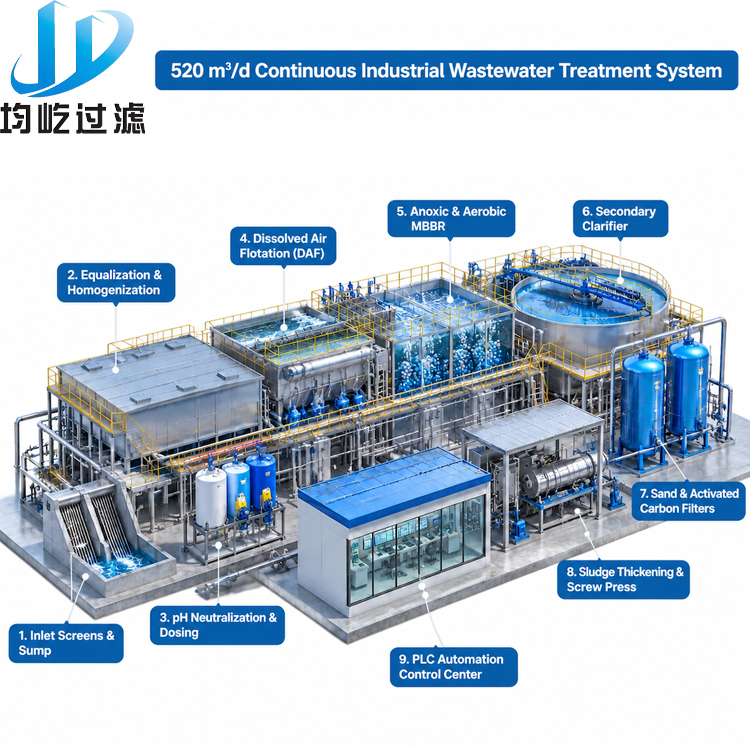
Enhanced Pretreatment, Resistant to High-Alkalinity Shock
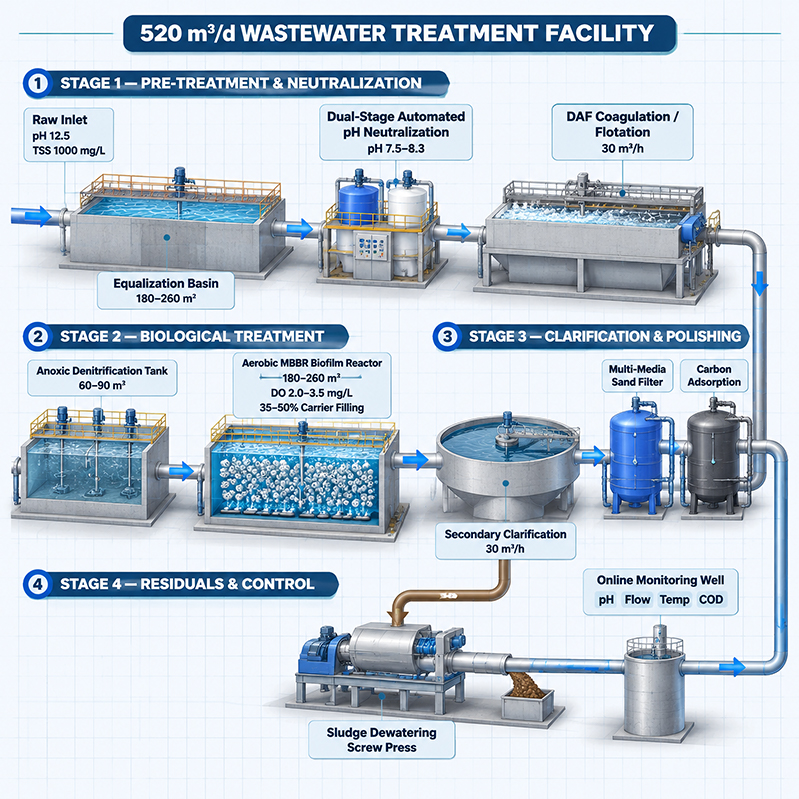
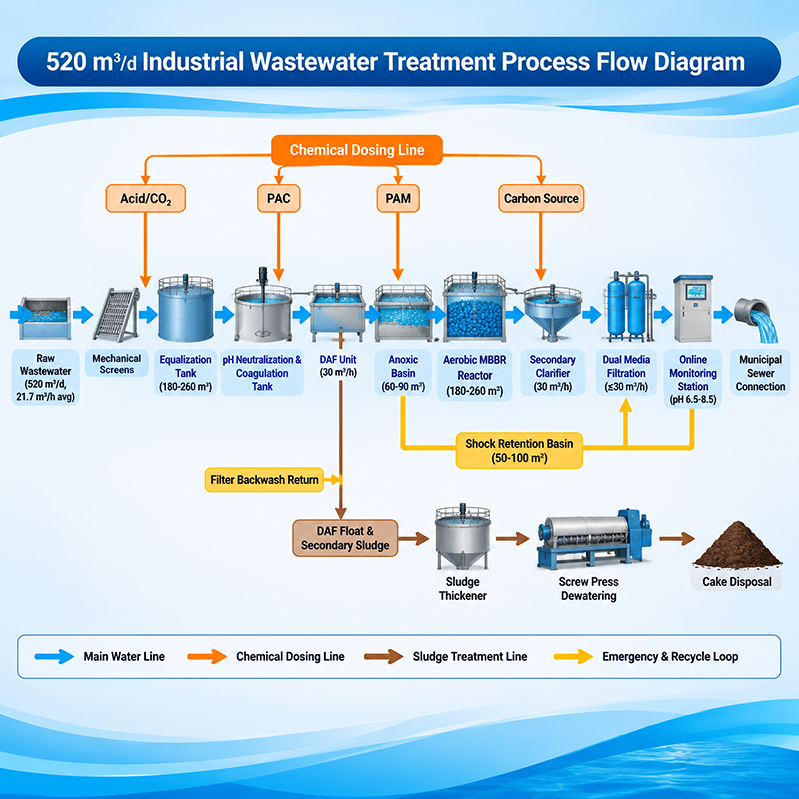
In response to the strongly alkaline characteristics of the influent with pH as high as 12.5, the system is equipped with a large-capacity equalization/homogenization tank (180–260 m³) and an automatic pH neutralization unit. Online pH closed-loop control is adopted, prioritizing acid agents or CO₂ for staged neutralization to ensure that the water quality entering the biological treatment section is stabilized within the optimal process window of pH 7.5–8.3, protecting the subsequent biological treatment system from acid-base shock.
Efficient Solid-Liquid Separation and Biological Treatment
Coarse and fine screens and a rotary drum screen are installed at the front end to effectively intercept suspended solids. For high TSS (up to 1,000 mg/L) and oily/surfactant-containing wastewater, a coagulation air flotation (DAF) unit is configured to significantly reduce the sedimentation load. The back end adopts the anoxic–aerobic MBBR (Moving Bed Biofilm Reactor) process, with a media fill ratio of 35%–50%, providing extremely strong shock resistance and excellent COD/BOD removal efficiency (BOD/COD ratio of approximately 0.62, indicating good biodegradability).
Advanced Purification and Stable Discharge
After mud-water separation in the secondary sedimentation tank, the biologically treated effluent enters the multi-media/sand filter and activated carbon filter for enhanced treatment, effectively removing residual suspended solids, surfactants, and odors. An online monitoring well is installed before discharge to continuously monitor pH, temperature, and flow rate, ensuring that only compliant water is allowed to be discharged into the municipal sewage network.
Comprehensive Emergency Protection Mechanism
The system is innovatively equipped with a 50–100 m³ emergency tank/exceedance return system. When severe abnormalities occur in the influent (such as severe pH deviation or chemical leakage) or when the effluent monitoring results are non-compliant, the system automatically closes the discharge valve and directs the abnormal water into the emergency tank for temporary storage or returns it to the equalization tank, completely eliminating the risk of environmental exceedance.
Main System Configuration List
Treatment Unit Core Equipment Design Parameters/Specifications
Pretreatment Area Coarse screen, fine screen/rotary drum screen Screen gap 10–20 mm / 1–3 mm, treatment capacity ≥30 m³/h
Equalization and Neutralization Equalization/homogenization tank, pH neutralization tank Effective volume 180–260 m³ / 20–40 m³, anti-corrosion and anti-seepage, automatic dosing
Physicochemical Separation Coagulation/flocculation tank, coagulation air flotation machine Air flotation treatment capacity 30 m³/h, including dissolved air tank, scum scraping and sludge discharge system
Biological Treatment Area Anoxic tank, aerobic MBBR tank Anoxic tank 60–90 m³; aerobic tank 180–260 m³, DO controlled at 2.0–3.5 mg/L
Sedimentation and Filtration Secondary sedimentation tank, multi-media/sand filter, activated carbon filter Treatment capacity 30 m³/h, backwash water returned to equalization tank
Sludge Treatment Sludge thickening tank, screw press/spiral dewatering machine Total effective volume 20–40 m³, achieving sludge reduction
Intelligent Control PLC/HMI control cabinet, online monitoring well Fully automatic dosing, level/pH interlocking, automatic switching and alarming for exceedance
Technical and Operational Indicators
Treatment capacity: average 21.7 m³/h; nominal equipment design capacity 30 m³/h (1.38 times margin reserved to cover fluctuations and backwash demand)
Effluent control targets: pH 6.5–8.5 (set at 8.0); TSS ≤100 mg/L (optimizable to ≤50 mg/L); COD ≤300–500 mg/L (subject to the local municipal discharge agreement)
System energy consumption: average operating power consumption of the entire system approximately 0.6–1.2 kWh/m³ (excluding winter heating/anti-freezing)
Floor area: approximately 430–660 m² (underground/semi-underground tank design may be adopted according to site conditions to save ground space)
Applicable Scenarios
Compliant discharge treatment of factory domestic sewage (including catering, bathing, etc.)
Industrial-domestic mixed wastewater containing high alkalinity, surfactants, and organic additives
Factory areas requiring discharge into the municipal sewage network with strict limits on COD, TSS, and pH
Environmental protection projects with a discharge volume of approximately 500 m³/d requiring continuous automated operation
Related products
-

Manual Hydraulic Filter Press for Wastewater Tr...
Design philosophy: simple but not simple Human-driven efficient filtering system Pure manual hydraulic mechanism: The lever type manual oil pump can produce a stable pressing force of up to 0.6MPa through simple reciprocating movement, without any external power source Intuitive mechanical feedback: The operator can intuitively grasp the pressing state through the pressure gauge, and the filtering process can be judged by the feel of the hand Double-undercurrent double-sided filter desi...
-

Manual Small Closed Filter Press for Precious M...
Product Features 1.Sealed chamber structure: Prevents material splashing, ensuring a safer and cleaner operating environment. 2.Manual jack compression: No power supply required, suitable for small-batch, intermittent production. Simple and reliable operation. 3.Closed discharge design: Prevents material from contacting the external environment, reducing volatilization and contamination. 4.High-quality filter plates: PP filter plates combined with flu...
-

Best Deal 450 Type Plate and Frame Filter Press...
Key Features 1.High-efficiency Pressing:The jack provides stable and high-strength pressing force, ensuring the sealing of the filter plate and preventing slurry leakage. 2.Sturdy structure: Utilizing a high-quality steel frame, it is resistant to corrosion and has strong compressive strength, suitable for high-pressure filtration environments. 3.Flexible operation: The number of filter plates can be flexibly increased or decreased according to the processing volume, meeting different produ...
-

SS304 7 Bag Filter Vessel DN250 Side In Bottom ...
Product features 1.A 7-bag parallel structure is adopted, enabling high-flow filtration with a single unit, reducing the floor space required. 2.The shell is made of SS304 stainless steel with a wall thickness of 5.0mm, featuring high structural strength and excellent corrosion resistance. 3.The design pressure is 1.6MPa, and the working pressure is 1.0MPa, meeting the requirements of conventional industrial pipeline pressure. 4.The flow direction is side entry and bottom exit, facilitating p...
-

High-precision Self-cleaning Filters Provide Hi...
1. The control system of the equipment is responsive and accurate. It can flexibly adjust the pressure difference and time setting value according to different water sources and filtration accuracy. 2. The filter element adopts stainless steel wedge wire mesh, high strength, high hardness, wear and corrosion resistance, easy to clean. Easily and thoroughly remove impurities trapped by the filter screen, cleaning without dead corners. 3. We use pneumatic valve, open a...
-

Cotton Filter Cloth and Non-woven Fabric
✧ Cotton Filter Cloht Material Cotton 21 yarns, 10 yarns, 16 yarns; high temperature resistant, non-toxic and odorless Use Artificial leather products, sugar factory, rubber, oil extraction, paint, gas, refrigeration, automobile, rain cloth and other industries; Norm 3×4、4×4 、5×5 5×6 、6×6 、7×7、8×8、9×9 、1O×10 、1O×11、11×11、12×12、17×17 ✧ Non-woven Fabric Product introduction Needle-punched non-woven fabric belongs to a kind of non-woven fabric, with...